When someone wants to improve their smile, it is completely normal to arrive at the clinic already thinking about a particular treatment.
“I want veneers.”
“I want to whiten my teeth.”
“I want to close this gap.”
“I want my teeth to look straighter.”
But in aesthetic dentistry, knowing what you would like to improve does not necessarily mean knowing which treatment you need.
A tooth that appears too small may simply be positioned incorrectly.
A smile that looks dull may only need whitening.
An asymmetry may come from the gums rather than the teeth.
Worn edges may be related to bruxism or an unstable bite.
And veneers placed without first analysing tooth position, lip dynamics or function can solve one problem while creating another.
This is why, at SMITA Advanced Smile Design in Barcelona, an aesthetic consultation does not begin by choosing a treatment.
It begins by understanding the smile.
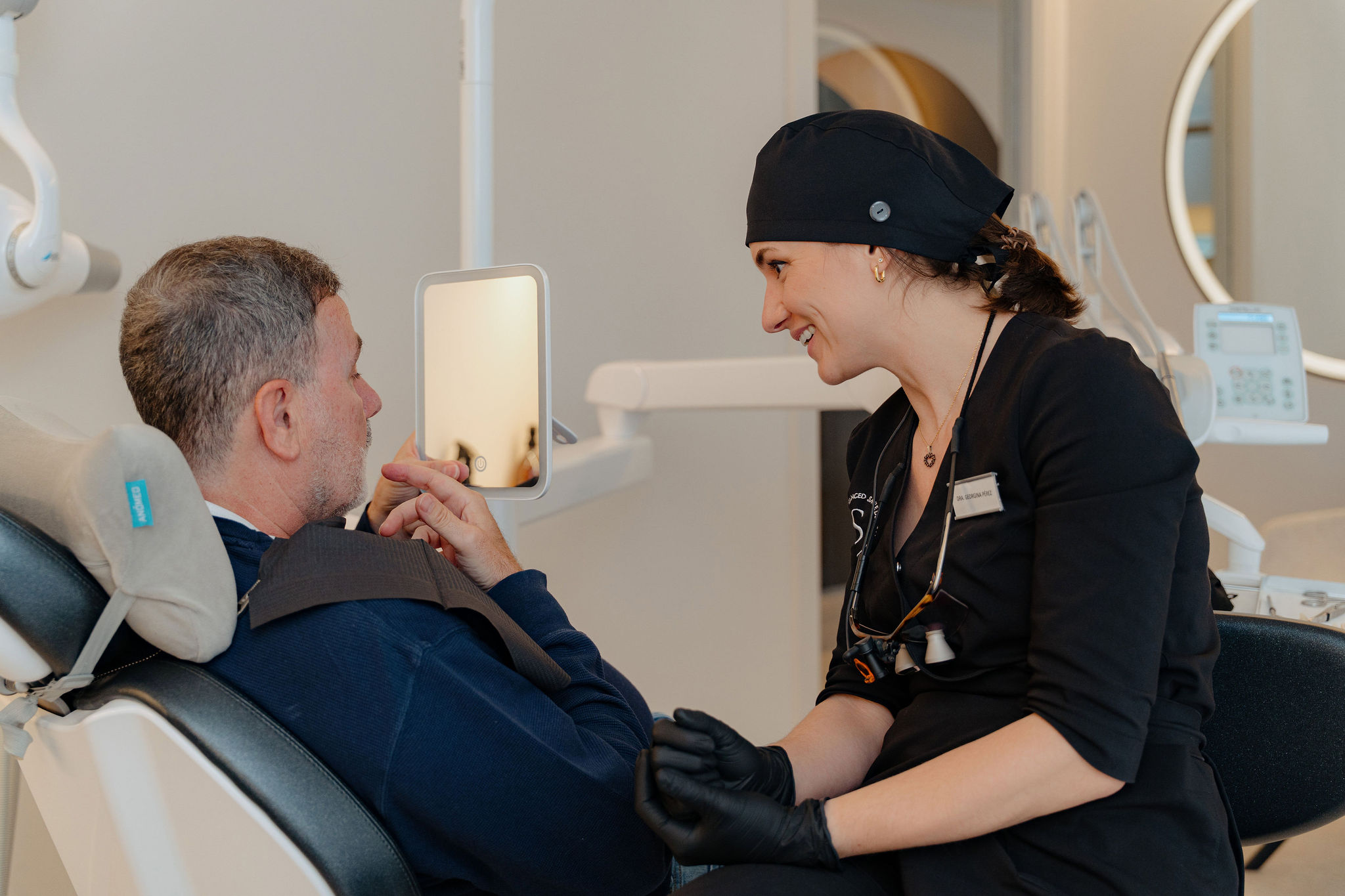
First, we want to understand what you would like to change
Before analysing teeth, photographs or proportions, something else comes first: listening to the patient.
What exactly do you dislike about your smile?
What would you like to improve?
Is there anything you would particularly like to preserve?
Are you looking for a subtle change or a more complete transformation?
Are you worried that the result could look artificial?
Two people with a very similar dental situation may want completely different outcomes.
One person may want brighter teeth and a highly balanced smile.
Another may prefer to preserve certain personal characteristics, tooth shapes or small asymmetries that form part of their natural expression.
For us, a well-designed smile is not one that follows a template.
It is one that fits the person wearing it.
Oral health always comes before aesthetics
Before designing a smile, we need to make sure that we have a healthy and stable foundation.
During the clinical assessment, we evaluate the general condition of the mouth and consider aspects such as:
Teeth and existing restorations
Dental decay or possible leakage around restorations
Condition of the enamel
Gums and periodontal health
Gum recession
Tooth wear
Fractures or cracks
Previous dental treatments
Missing teeth
Bite and dental contacts
When clinically indicated, we complement the examination with radiographs and other diagnostic records.
There is little value in designing a beautiful smile if the underlying situation first needs to be stabilised.
Aesthetics should begin with health.
Photography: seeing the smile from another perspective
Photography is an essential part of aesthetic analysis.
Its purpose is not simply to document a “before and after”.
Photographs allow us to study details that can easily be missed during a conventional dental examination.
We can analyse the smile in relation to:
The face
The lips
The gums
The midline
Dental proportions
The amount of tooth displayed
Tooth inclination
The smile line
Asymmetries
Facial expression
Photographs also allow patients to see their own smile from a different perspective.
Sometimes, what initially appears to be only a colour problem is also related to tooth shape, position or wear.
And sometimes the opposite happens: something that initially seems to require complex treatment can actually be improved much more conservatively.
We do not analyse isolated teeth: we analyse the complete smile
One of the most common mistakes in aesthetic dentistry is to focus exclusively on the front teeth.
But a smile exists within a face.
This is why we evaluate how the teeth relate to the lips, gums and principal facial references.
Among other factors, we analyse:
The facial and dental midlines
The amount of tooth visible when smiling
Incisor display at rest
The line created by the incisal edges
The relationship between this curve and the lower lip
Smile width
Symmetry
Tooth position and proportions
Gum display
Our goal is not to turn every smile into the same idealised smile.
These references help us understand which characteristics create harmony within each individual face.
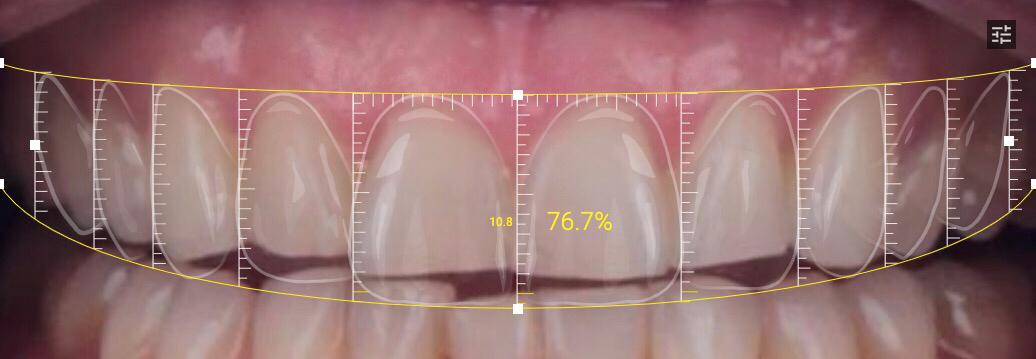
Dental proportions matter, but they are not a mathematical formula
Smile design involves analysing the width, length and visual relationship between different teeth.
The central incisors are particularly important because they usually dominate the composition of the smile.
However, applying exactly the same mathematical proportions to every patient can produce an artificial result.
Age, facial anatomy, lip shape, individual smile characteristics and the natural anatomy of the teeth all influence the design.
This is why proportions should be considered a guide.
Not a template.
A natural smile requires coherence, but it also needs individuality.
The gums are part of the design too
A person may have beautifully shaped, bright teeth and still feel that the smile is not completely balanced.
Very often, the explanation lies in the gums.
During an aesthetic assessment, we may analyse:
The height of the gingival margins
Symmetry between both sides
The amount of gum displayed when smiling
Inflammation
Gum recession
The contour around each tooth
The relationship between the gums, tooth length and lips
Sometimes no gum treatment is necessary.
In other cases, improving gingival health or making a small correction can completely change the proportions of the smile.
For this reason, gum aesthetics are part of Digital Smile Design and should not be considered separately from the teeth.
Tooth position can completely change the treatment plan
Before changing the shape of a tooth with composite or porcelain, we should ask a very simple question:
Is the problem really the shape of the tooth, or is it its position?
A rotated incisor may appear narrower.
An inclined tooth may appear disproportionately large.
Crowding may affect the smile line.
A tooth positioned too far forwards may require unnecessary removal of tooth structure if we attempt to correct it directly with a veneer.
In these situations, orthodontics can become part of the aesthetic design.
Moving the teeth first can allow us to perform much smaller and more conservative restorative treatments afterwards.
And sometimes, after orthodontic treatment, the patient discovers that considerably less restorative treatment is required than originally expected.
We also analyse the bite and bruxism
A smile cannot be designed only for a photograph.
It has to function every day.
Teeth come into contact while speaking, chewing, swallowing and during mandibular movement. Some people also clench or grind their teeth during the day or while sleeping.
This is why we evaluate:
How the upper and lower teeth come together
Which teeth receive greater forces
Existing tooth wear
Signs associated with bruxism
Fractures or small cracks
Mandibular movements
The space available for future restorations
Bite stability
This is particularly important when teeth are worn or when we are considering bonding, veneers, reconstructions or more extensive rehabilitation.
An aesthetic smile must also be functional and stable.
Tooth colour should be planned at the right stage
Another reason not to begin immediately with restorations is colour.
If a patient would like a brighter smile and also needs composite bonding, veneers or visible crowns, it may be advisable to whiten the natural teeth first.
Restorative materials do not whiten in the same way as natural tooth structure.
Therefore, when indicated, we can first improve the colour of the natural teeth, allow the shade to stabilise and only then select the definitive colour of the restorations.
This avoids choosing a restoration shade too early and potentially limiting the final result.
Digital Smile Design: planning before transforming
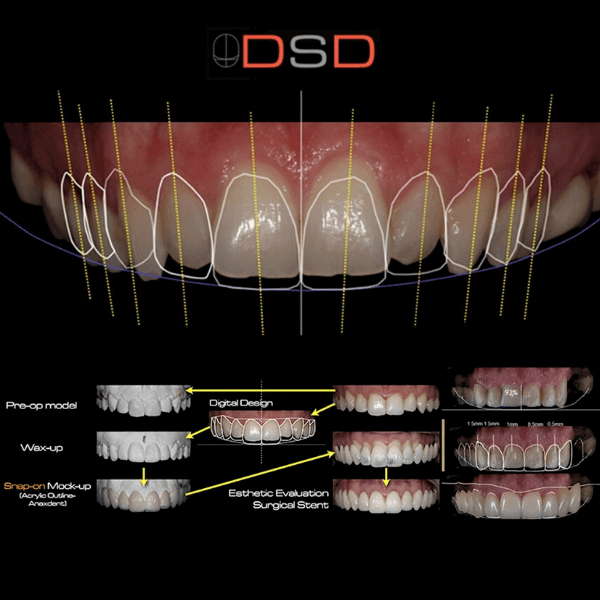
In aesthetic cases, we use the philosophy of Digital Smile Design to study the desired result before making irreversible changes.
Planning may combine photographs, facial analysis, digital records and other tools depending on the complexity of the case.
The objective is not simply to create an attractive image on a screen.
The objective is to understand:
Where the teeth should ideally be positioned
Which tooth length creates better harmony
Which proportions work best
How the teeth will relate to the lips
What role the gums play
Which treatments are genuinely necessary
How much natural tooth structure we can preserve
When appropriate, this planning can later be transferred into an aesthetic trial or mock-up, allowing the patient to experience certain changes directly in their own smile before the definitive treatment begins.
The most conservative treatment may be the best treatment
A good aesthetic consultation should not necessarily end with a long list of procedures.
Sometimes, after analysing the smile, we discover that only a small intervention is necessary.
For example:
Teeth whitening
Minor dental contouring
Rebuilding one or two incisal edges with composite
Correcting tooth position with orthodontics
Improving gum health
Replacing an old restoration
Or simply maintaining and monitoring the existing situation
In other cases, several disciplines may need to be combined.
For example:
Orthodontics → whitening → composite bonding
Or:
Gum treatment → whitening → veneers
Or even:
Orthodontics → bite stabilisation → restorative rehabilitation
The sequence is completely different from one person to another.
The best aesthetic dentistry is not the dentistry that performs the most treatment. It is the dentistry that achieves the right result while doing only what is necessary.
Composite or porcelain: the decision comes afterwards
Another common question during the first consultation is whether composite or porcelain would be better.
But first, we need to understand what we are trying to correct.
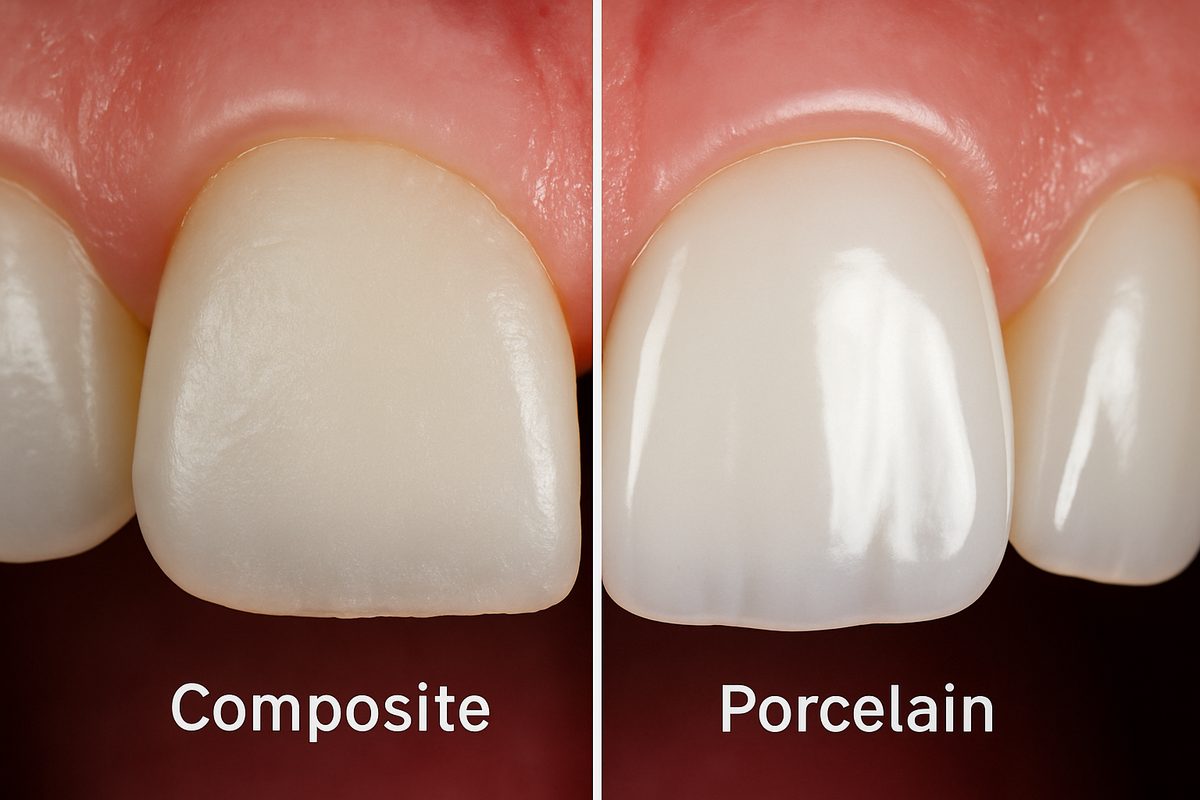
Composite can be an excellent option when we need to add small amounts of material, rebuild tooth edges, close certain spaces or modify proportions conservatively.
Porcelain may be more appropriate when different changes in shape, structure, colour or resistance are required.
Neither material is automatically better.
The choice depends on:
The initial dental situation
The amount of available enamel
The change required
The bite
Bruxism
Tooth colour
The number of teeth involved
The patient’s expectations
Long-term maintenance
This is why we first design the desired result and then decide how best to achieve it.
What happens after the first assessment?
Once we have gathered the necessary information, we can establish a diagnosis and discuss the different treatment possibilities.
In simple cases, the solution may be relatively straightforward.
In more complex cases, additional study may be necessary before establishing the definitive treatment sequence.
Our objective is for the patient to understand:
What we see
What can be improved
What should be preserved
Which options are available
Which treatment sequence we recommend
Why we recommend each step
The patient should be able to participate in decisions about their own smile.
This is especially important in aesthetic dentistry, where there is rarely only one technical answer. Personal preferences also matter.

How we understand the first aesthetic consultation at SMITA
At SMITA Advanced Smile Design, we see the first consultation as an opportunity to understand the patient, their oral health and their smile before discussing solutions.
Our approach combines diagnosis, aesthetic planning, function and a conservative philosophy.
We do not want every patient to have the same teeth.
We do not aim to remove every small individual characteristic.
And we do not recommend veneers simply because someone wants to improve their smile.
We want to identify which changes can make a meaningful difference and determine the most respectful way to achieve them.
Sometimes that means orthodontics.
Sometimes whitening.
Sometimes composite.
Sometimes porcelain.
Sometimes gum treatment.
Sometimes a carefully planned combination.
And sometimes, considerably less treatment than the patient initially imagined.
Because before transforming a smile, we first need to understand it.
Frequently Asked Questions
What happens during a first aesthetic dental consultation?
We assess your oral health and discuss which aspects of your smile you would like to improve. Depending on the case, we may use clinical examination, photographs, radiographs when indicated and other diagnostic records to analyse the teeth, gums, bite, proportions and overall aesthetics.
Do I need to know which treatment I want before my consultation?
No. In fact, you do not need to know at all. You can simply explain what you would like to improve about your smile. We then analyse the origin of the concern and discuss the different possibilities.
Will I be recommended veneers if I want to improve my smile?
Not necessarily. Depending on the case, whitening, orthodontics, composite bonding, gum treatment or even no restorative treatment may be more appropriate. Veneers are only one of the possible tools within smile design.
Why are photographs taken when analysing the smile?
Photographs allow us to analyse the teeth in relation to the lips, gums and face. They also help us study proportions, symmetry, smile line and other aesthetic details that are important during treatment planning.
What is Digital Smile Design?
Digital Smile Design is an approach to analysing and planning the smile using facial, dental and digital information. It helps us study the relationship between the teeth, gums, lips and face before making certain treatment decisions.
Can I see what my smile could look like before treatment?
In selected cases, we can create an aesthetic plan followed by a mock-up or smile trial. This allows certain changes to be assessed before beginning definitive treatment.
Is it better to have orthodontics before veneers?
It depends on the position of the teeth. When teeth are inclined, rotated or crowded, moving them first can make the following treatment considerably more conservative or even reduce the need for restorations.
Should I whiten my teeth before having veneers?
Not always. However, if you would like to lighten your natural teeth and also require visible restorations, it is important to consider tooth colour before the definitive restorations are made.
What happens if I have bruxism?
Bruxism should be considered during treatment planning. It can cause tooth wear and increase forces on both teeth and restorations, so the bite, protection and long-term maintenance become part of the treatment strategy.
How can I book an aesthetic consultation at SMITA Barcelona?
You can book a consultation with our team to analyse your smile, discuss your objectives and explore the most appropriate treatment possibilities in a personalised way.
Learn more about the SMITA team:
Book your appointment: