When we think about improving a smile, it is easy to focus only on the teeth.
Their colour.
Their shape.
Their length.
Whether they are straight.
Whether there are spaces between them.
But a smile never exists in isolation.
It belongs to a face.
It moves with the lips.
It changes when we speak.
It transforms when we smile spontaneously.
It interacts with the gums, facial expression, proportions and the unique characteristics of each person.
This is why, at SMITA Advanced Smile Design in Barcelona, when we plan certain aesthetic treatments, we do not simply study what the teeth should look like.
We study how those teeth should relate to the person who wears them.
This is one of the fundamental principles of facial analysis in smile design.
A smile can look beautiful up close and still not work within the face
We can look at an enlarged photograph of perfectly aligned teeth and think that they are aesthetically beautiful.
But once we zoom out and see the entire face, our perception may change.
Perhaps the incisors appear too short.
Perhaps they are too dominant.
Perhaps the line of the teeth does not follow the lower lip.
Perhaps the smile feels too rigid.
Perhaps the design is technically symmetrical, yet somehow does not fit the facial expression.
This happens because dental aesthetics are not determined only by each individual tooth.
They depend on the relationships between:
The face
The lips
The teeth
The gums
The smile
The proportions
Movement
Function
This is why designing a smile by looking only at dental models gives us incomplete information.
We need to widen the perspective.
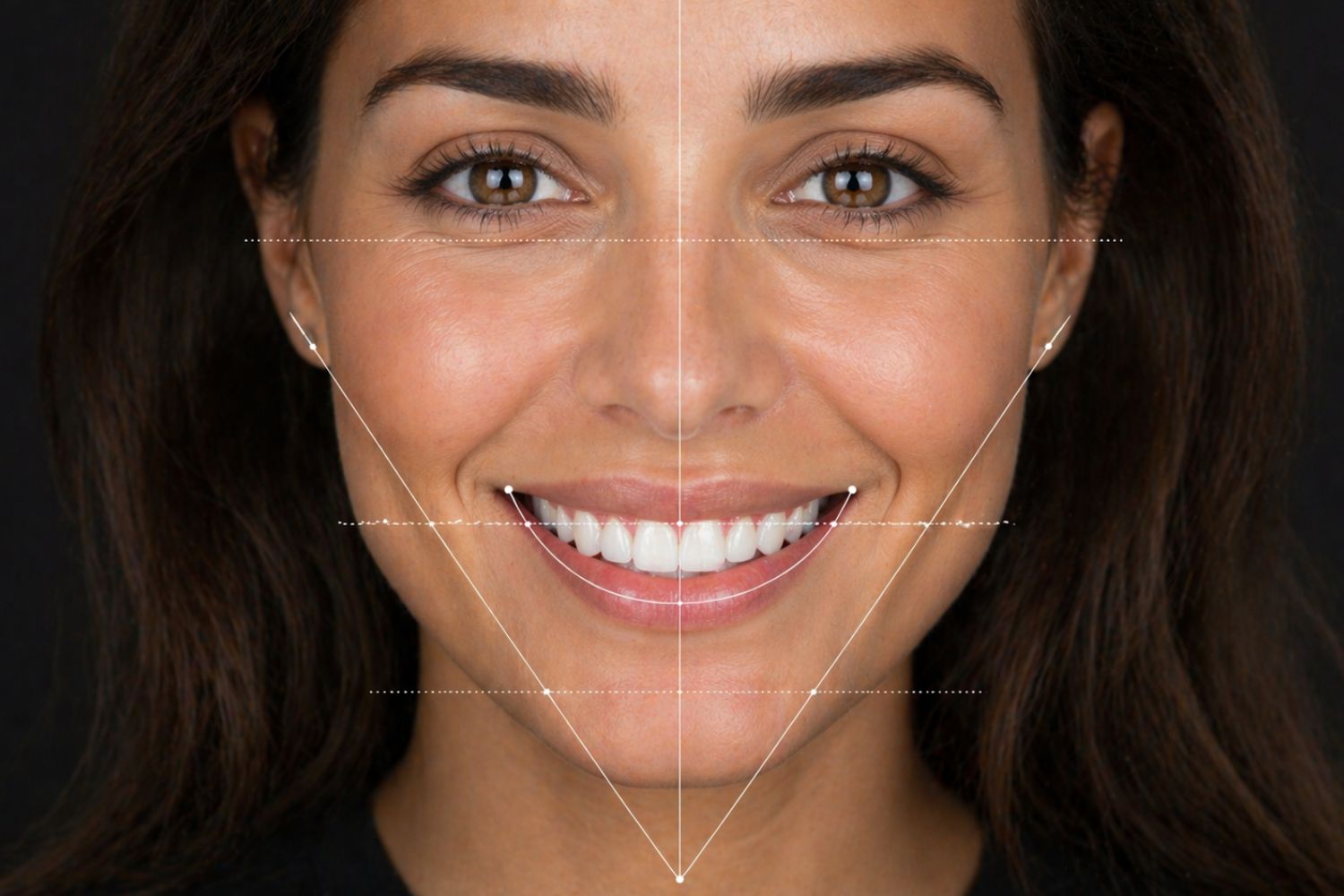
What is facial analysis in smile design?
Facial analysis involves studying certain references of the face and smile to understand how the teeth should integrate into the overall appearance.
It does not mean that there is a formula capable of automatically calculating the perfect smile.
And it does not mean that all faces should follow exactly the same proportions.
Instead, we use different references to guide our analysis.
For example:
The facial midline
The position of the eyes
The general orientation of the face
The position and movement of the lips
The smile line
Tooth display
The amount of gum visible
The relationship between the incisal edges and the lower lip
The visible width of the smile
Dental proportions
These references help us identify balance, asymmetries and opportunities for improvement.
But they must always be interpreted within the context of the individual person.
Facial analysis is a guide for personalisation, not a template for standardisation.
The facial midline: an important reference, but not an absolute rule
One of the first references we can study is the facial midline.
In simplified terms, this is a vertical line that visually divides the face into two sides.
We can then compare it with the dental midline, which is the line between the two upper central incisors.
When both coincide, this may create a sense of balance.
But they do not always need to match mathematically for a smile to look attractive.
Many people naturally have small facial asymmetries.
The nose may deviate slightly.
The chin may not be perfectly centred.
The lips may move differently on each side.
Even the eyes may sit at slightly different heights.
For this reason, we do not pursue geometric symmetry obsessively.
Instead, we ask a more important question:
Does the dental midline appear harmonious within that particular face?
A small deviation may be almost invisible.
By contrast, a noticeable inclination of the central incisors can have a much greater impact on the perception of the smile.
Diagnosis should distinguish between what is mathematically different and what is aesthetically relevant.
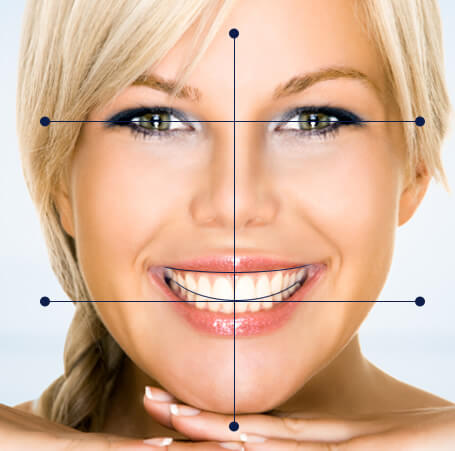
Horizontal references help us understand the orientation of the smile
We can also study different horizontal references within the face.
One of the best known is the interpupillary line, which visually relates the position of the two eyes.
We may also observe the orientation of the lips and the corners of the mouth.
These references help us evaluate whether the dental plane appears balanced within the face.
For example, we can analyse whether the upper dental line appears excessively tilted in relation to the facial features.
But once again, facial references are not always perfectly parallel to one another.
Human faces are not geometric structures.
These lines are therefore tools for analysis.
Not rules that force everything to be mathematically perfect.
The smile line: when teeth and lips work together
One of the most important relationships in aesthetic dentistry is the relationship between the edges of the upper teeth and the lower lip.
When we smile, the incisal edges of the incisors and canines create a curve.
This curve may follow the shape of the lower lip more or less harmoniously.
This relationship is part of what we refer to as the smile line or smile arc.
A smile arc that is too flat can make the smile appear older or less dynamic.
This may occur, for example, when the incisors have become worn.
On the other hand, incisors that are excessively long can also disturb the balance.
The objective is not to create an exaggerated curve.
It is to create an attractive relationship between the teeth and lips.
This is why even very small changes in incisor length can significantly change the overall perception of the smile.
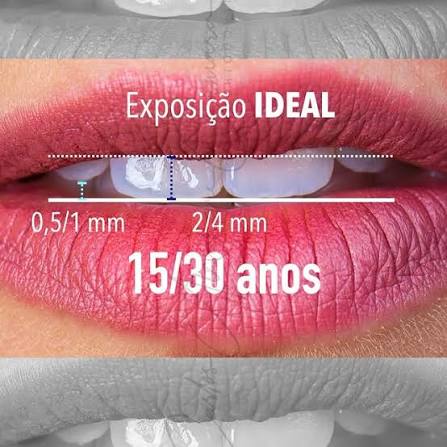
Tooth display at rest also tells us a great deal
We do not analyse only the maximum smile.
We also observe what happens when the lips are relaxed.
How much of the upper incisors is visible?
Can the teeth be seen during speech?
Are the incisors largely hidden?
Is there visible wear?
How does tooth display change with lip movement?
The amount of tooth visible at rest varies greatly from one person to another and can also change over time.
The lips, age, tooth length, incisor position and tooth wear all influence this relationship.
For this reason, when we are considering lengthening teeth, performing composite bonding or designing veneers, we should not study only a full-smile photograph.
We also need to understand how the teeth will appear during much more natural expressions.
The lips are a fundamental part of smile design
The lips create the frame of the smile.
But they are a dynamic frame.
They do not remain still.
They rise.
They fall.
They open.
They compress.
They change during speech.
And they can show very different amounts of tooth and gum depending on the expression.
This is what we mean when we refer to lip dynamics.
Two patients with almost identical teeth can have completely different smiles because their lips behave differently.
One person may show a large amount of tooth.
Another may show very little.
One may display gum when smiling.
Another may cover a significant part of the incisors.
One may have a very broad smile.
Another may show fewer posterior teeth.
The smile design must adapt to these characteristics.
We cannot design teeth without first understanding the frame in which they will appear.
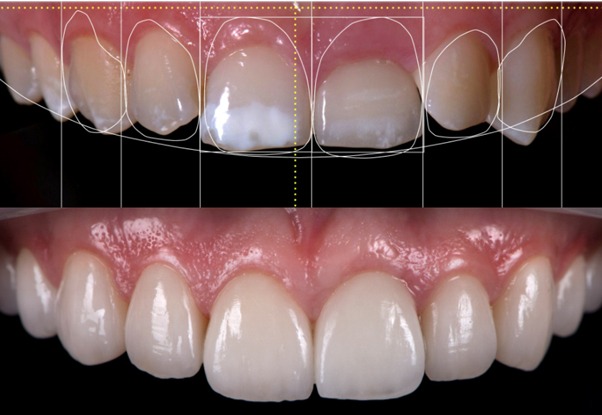
The gums change visual proportions
When analysing the face and smile, we also need to observe the gingival architecture.
The gums determine where each tooth visually begins.
This means they can significantly influence the perception of tooth length and proportion.
An incisor may look too short because it genuinely is short.
But it may also appear short because part of its natural anatomy is covered by gum tissue.
We may analyse:
The height of the gingival margins
Symmetry between similar teeth
The amount of gum visible when smiling
Inflammation
Gum recession
The shape of the gingival contour
The relationship between the gums and tooth length
Before adding material to a tooth that appears too small, we need to understand whether the problem is really in the tooth itself.
Sometimes the answer lies in tooth position.
Sometimes in the gums.
And sometimes in a combination of both.
This is precisely what makes smile design interdisciplinary.
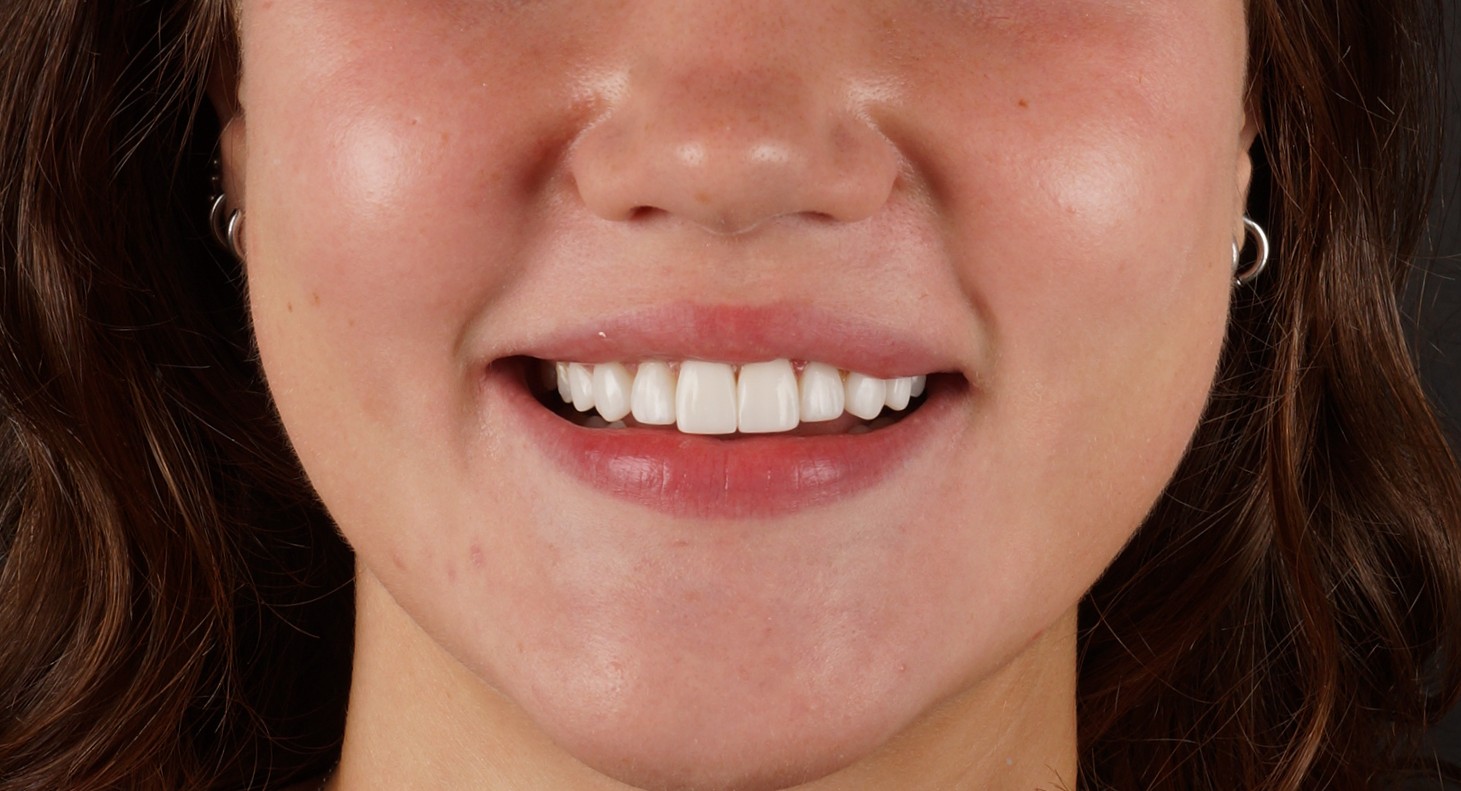
The central incisors play a leading role
Within the dental composition, the two upper central incisors usually have a particularly strong influence.
They are often the teeth with the greatest visual presence in the smile.
Their length, width, inclination and position affect the entire composition.
If they are too short, the smile may lose presence.
If they are too long, they can become overly dominant.
If they are tilted, even a correctly positioned midline may appear displaced.
If one has a noticeably different shape from the other, the asymmetry may draw attention.
For this reason, the central incisors often serve as a visual reference around which the rest of the smile is organised.
But this does not mean that we try to turn them into two identical, artificial shapes.
Naturalness allows small variations.
Are there perfect dental proportions?
In aesthetic dentistry, different mathematical concepts can help us study proportions.
We can analyse width-to-length ratios.
We can compare central incisors, lateral incisors and canines.
We can assess how much of each tooth is visible from the front.
These references are useful.
But turning them into absolute rules can be a mistake.
The same proportion will not necessarily work in a small, delicate face and in a face with stronger features.
Nor will it necessarily work in two people with different lips, smiles and anatomy.
For this reason, at SMITA we see proportions as analytical tools.
Not as formulas that must be copied exactly.
A natural smile needs proportion, but it also needs identity.
Tooth shape and visual personality
Teeth can create different visual impressions depending on their shape.
Straighter contours can produce a different effect from softer, more rounded shapes.
Incisal angles can be sharper or more delicate.
Lateral incisors can have more or less prominence.
Canines can integrate very discreetly or provide more structure to the smile.
However, we do not believe in rigid classifications where a specific personality must automatically receive a specific tooth shape.
The design process is much more subtle.
We observe the face.
The existing teeth.
Age.
Expression.
The patient’s preferences.
And especially which natural characteristics are worth preserving.
Ideally, after treatment, the first thing people notice should not be the restorations.
They should simply see a harmonious and natural smile.
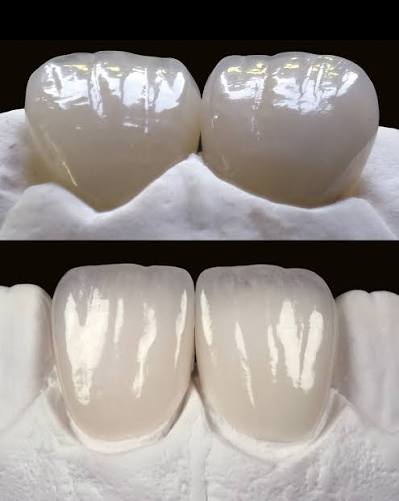
Symmetry does not automatically mean naturalness
There is a common belief that an aesthetic smile must be perfectly symmetrical.
But nature is rarely perfectly symmetrical.
One lateral incisor may be slightly different from the other.
One side of the lip may lift more.
The gingival margins may show a small variation.
The face itself may contain natural asymmetries.
Removing every one of these characteristics can produce a smile that feels too rigid.
This is why we distinguish between:
Asymmetries that contribute to naturalness
Asymmetries that are visually irrelevant
Asymmetries that genuinely disturb the harmony of the smile
We do not treat a difference simply because we can measure it.
We first decide whether it has real aesthetic or functional significance.
A smile should be studied in movement
A frontal photograph is extremely useful.
But it does not tell the entire story.
People do not exist frozen in a single image.
They speak.
They laugh.
They smile softly.
They smile broadly.
They move their jaw.
They move their lips.
The perception of the teeth changes constantly.
For this reason, dynamic smile analysis can be extremely valuable.
It helps us understand:
When the teeth begin to appear
How much tooth is visible during speech
How the upper lip rises
How the incisors relate to the lower lip
How much gum is visible during a spontaneous smile
How the smile changes through different expressions
A design that works only in a static photograph may not work in exactly the same way in real life.


Facial analysis can change the treatment recommendation
This is one of the most important reasons to perform it.
Imagine that a patient feels their incisors are too small.
We could immediately think about adding composite or placing veneers.
But the analysis may reveal very different situations.
Perhaps there is tooth wear and we genuinely need to restore length.
Perhaps the teeth are inclined and appear shorter because of their position.
Perhaps the gums cover part of the natural anatomy.
Perhaps the lips show very little tooth even though the dental length is correct.
Perhaps only a subtle modification of the incisal edges is needed.
The same aesthetic concern can have completely different causes.
And each cause requires a different solution.
This is why diagnosis should come before the material.
Facial analysis can help us be more conservative
Good aesthetic planning should not be used to justify treatment.
It should help us determine how much treatment is genuinely necessary.
When we better understand the relationship between the teeth and the face, we can make more precise decisions.
We may discover that the patient only needs:
Teeth whitening
Small composite adjustments
Orthodontics to improve tooth position
A localised gingival correction
Reconstruction of worn incisal edges
Very conservative contouring
Or even no restorative treatment at all
In other cases, veneers or a more extensive rehabilitation may be indicated.
But these should be the consequence of diagnosis.
Not the starting point.
When tooth position changes the facial aesthetics of the smile
The position of the teeth has an enormous influence on how we perceive their shape.
A rotated tooth shows less of its front surface and may appear narrower.
An incisor inclined forwards may seem more prominent.
A tooth positioned further inwards may be visually hidden.
Differences in vertical position can alter the smile arc.
Tooth position can even make the dental midline appear different.
For this reason, orthodontics can become part of smile design in selected cases.
Moving the teeth first can help us:
Improve symmetry
Create better visual proportions
Optimise the smile line
Distribute spaces more effectively
Reduce the volume of future restorations
Avoid unnecessary tooth preparation
Preserve more enamel
In some situations, orthodontics changes the smile so significantly that only very small aesthetic refinements are required afterwards.
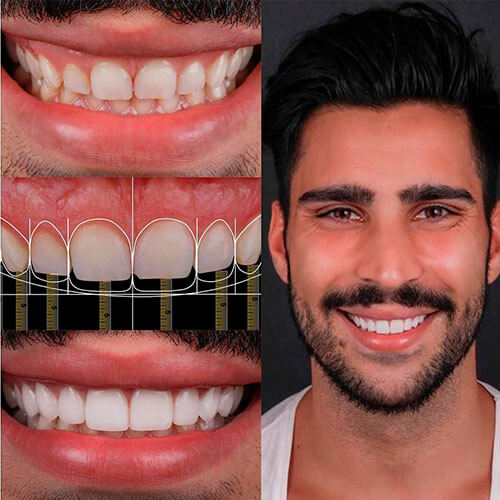
Facial analysis before veneers
When veneers are being considered, facial analysis becomes particularly important.
Before deciding on tooth length, shape or the number of teeth to treat, we need to understand how the restorations will appear within the face.
A design that is too uniform may look artificial.
Teeth that are too wide may dominate the smile.
Incisors that are excessively long may interfere with function or disturb facial harmony.
Excessive volume can even alter the way the lips appear.
And trying to compensate for unfavourable tooth positions using porcelain alone may require removing more tooth structure than necessary.
This is why we do not start by asking:
“What veneer shape would you like?”
We first ask:
“Which design works for this smile, and what is the most conservative way to achieve it?”
Colour should also suit the individual
Facial analysis does not determine only shape and proportions.
It also reminds us that tooth colour should be observed within the overall facial context.
A very bright shade may look elegant in some situations.
In others, it may dominate the face too much.
The perception of tooth colour can be influenced by:
Skin tone
Lip colour
Lighting
Age
Natural enamel translucency
Tooth shape
The amount of tooth visible
But we also avoid simplified rules that automatically assign a tooth shade based on skin tone.
Colour should be selected while observing the entire smile and, importantly, respecting the patient’s preferences.
Natural does not necessarily mean dark.
And bright does not have to mean artificial.
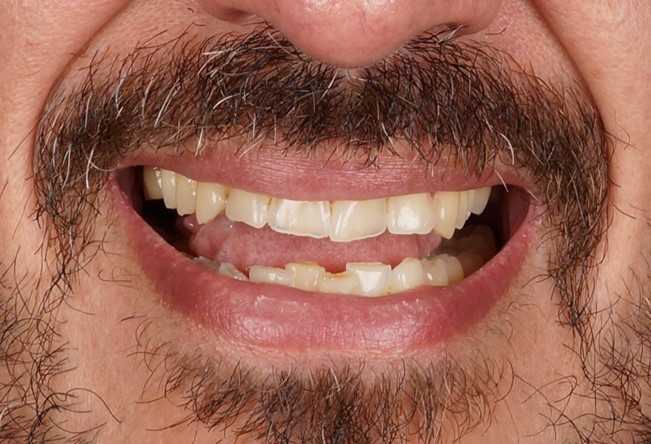
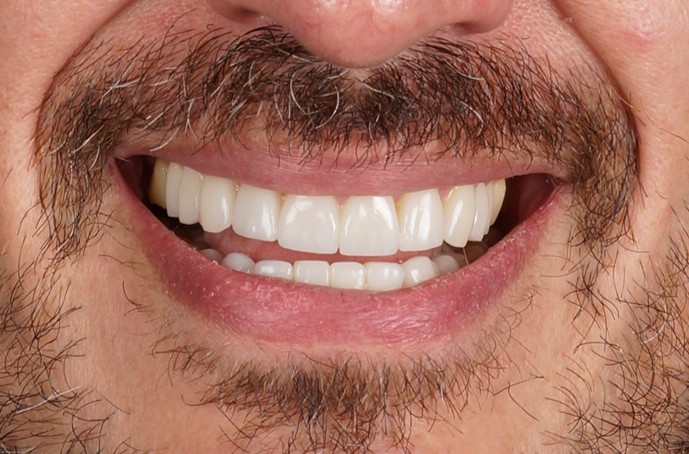
A mock-up brings facial analysis into the mouth
After studying the smile and creating a proposal, in selected cases we can perform a dental mock-up.
This allows us to transfer the proposed design temporarily onto the teeth.
We can then observe the face again.
Does the length work?
Do the teeth have too much volume?
Does the curve follow the lower lip?
Do the central incisors have enough presence?
Does the patient recognise themselves in the design?
This is especially important because there is a difference between analysing a smile on a screen and seeing it directly within the face.
The mock-up makes the design much more tangible.
And it allows us to refine the proposal before making certain definitive decisions.
Digital Smile Design does not mean creating a digital smile and simply copying it
Digital Smile Design is sometimes interpreted as if software automatically generated the perfect smile.
For us, its value is very different.
Technology helps us:
Document
Analyse
Measure
Compare
Communicate
Visualise
Plan
But clinical decisions still require professional judgement.
We need to interpret anatomy.
Health.
Function.
Tooth position.
Gingival tissues.
The lips.
The face.
And the patient’s preferences.
Technology can help us see more clearly.
But it does not replace diagnosis.
Function remains part of smile design
Facial harmony is fundamental, but a smile also has to function.
If we decide to lengthen incisors or modify their edges, we need to study how these teeth will contact the lower teeth.
If there is wear, we need to understand why.
If bruxism is present, it must be taken into account.
If the bite is unstable, we may need to evaluate how this could affect future restorations.
For this reason, aesthetic treatment cannot end with a frontal photograph.
The smile belongs to a functional system.
Aesthetics, function and stability should be planned together.

The smile changes over time
We should also remember that a smile is not static throughout life.
Teeth wear.
Gums may change.
Lips change over time.
Tooth position can shift.
Restorations require maintenance.
Bruxism can affect the teeth.
This is why, when designing a smile, we also think about the future.
A good result should not only look attractive on the day treatment is completed.
It should also be maintainable, reviewable and adaptable over time.
How we approach smile design at SMITA
At SMITA Advanced Smile Design in Barcelona, our philosophy begins with a global assessment.
First, we listen to what the patient would like to improve.
Then we assess oral health.
We analyse the teeth.
We study their position and proportions.
We evaluate the gums.
We assess the smile.
We observe the lips.
We relate the teeth to the face.
We analyse the bite when indicated.
And only then do we begin to decide which treatments may help us achieve the desired result.
In some cases, whitening may be enough.
In others, orthodontics may be advisable.
Small details may need to be refined with composite.
Gum treatment may be indicated.
Some patients may benefit from carefully planned veneers.
And certain complex cases require an interdisciplinary combination of treatments.
Every smile follows a different path.
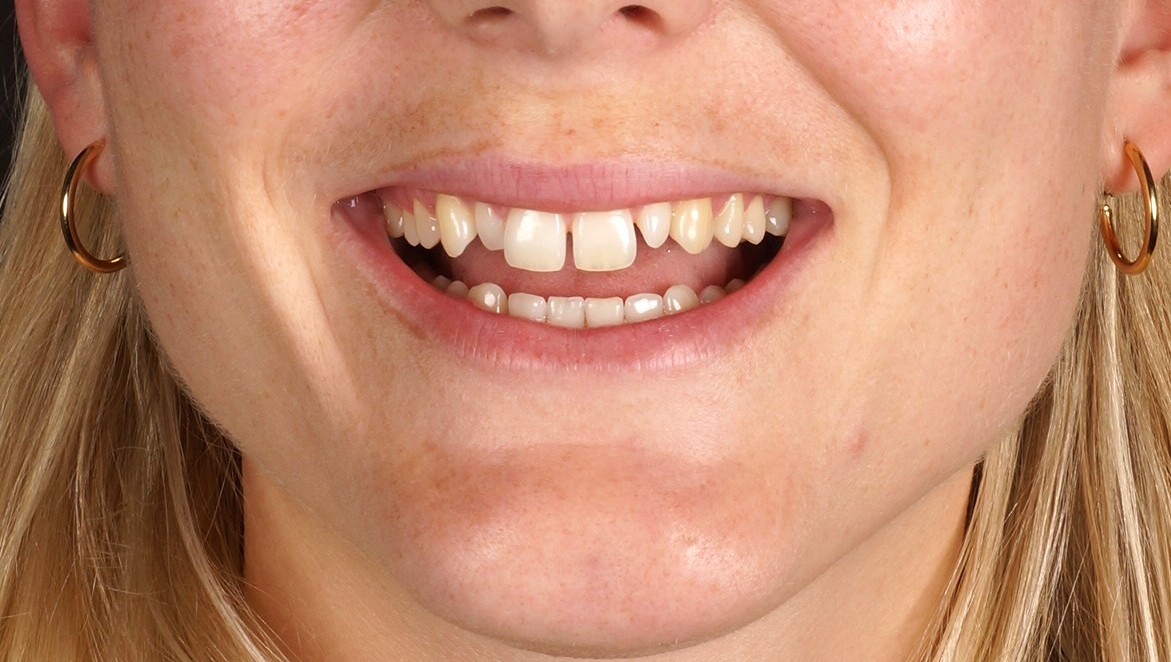
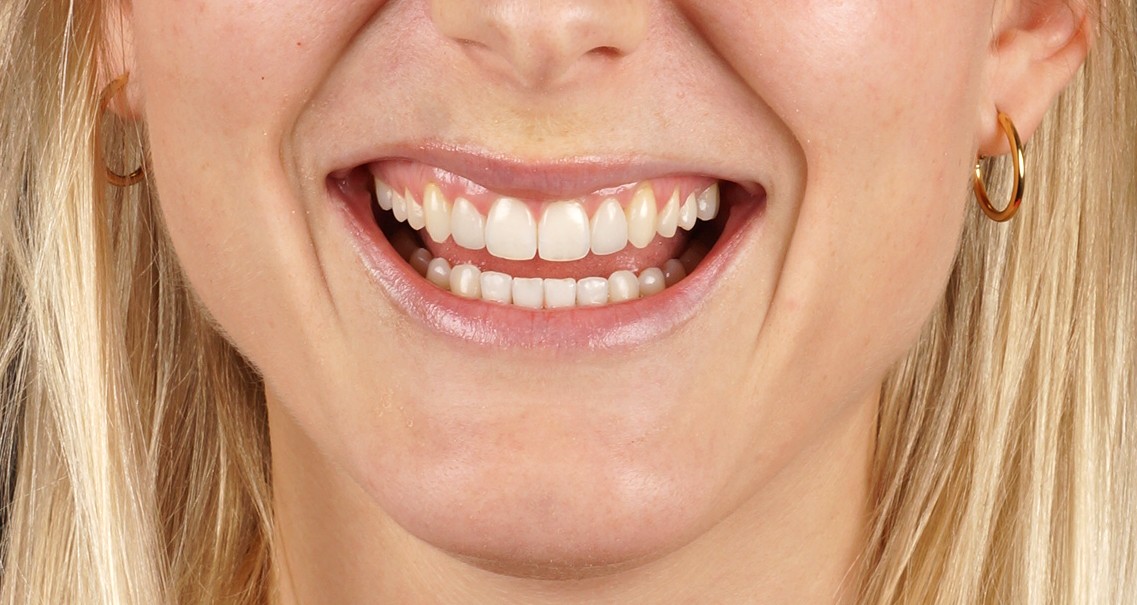
The objective is not to design a perfect smile
The word “perfect” can be problematic in aesthetic dentistry.
Perfect according to which reference?
Perfectly symmetrical?
Perfectly white?
Perfectly aligned?
A smile can meet all of these criteria and still look artificial.
We are more interested in another idea:
Harmony.
Proportions that make sense.
Teeth that work within the face.
A smile that follows the lips.
Balanced gums.
A healthy result.
Stable function.
A patient who still recognises themselves.
And a treatment that preserves as much natural tooth structure as possible.
This is far more important than pursuing mathematical perfection.
A smile should look like yours
Facial analysis reminds us of something essential.
We are not designing teeth for a photograph.
We are designing a smile for a person.
A person who speaks.
Who smiles.
Who laughs.
Who expresses themselves.
Who changes over time.
This is why, before deciding on length, shape, colour or material, we need to look beyond the teeth.
At the face.
The lips.
The gums.
Movement.
Expression.
And understand which characteristics make that smile genuinely belong to that person.
At SMITA, we believe that the most sophisticated aesthetic result is not the one where everyone immediately notices that dental treatment has been performed.
It is the one where the smile simply appears more balanced, brighter, healthier and natural.
Without losing its identity.
Frequently Asked Questions
What is facial analysis in smile design?
It is the study of the relationship between the teeth, lips, gums and certain facial references. It helps us understand which dental proportions and positions may be more harmonious for each individual person.
Which facial lines are analysed in smile design?
We may use references such as the facial midline, interpupillary orientation, position of the corners of the mouth, dental midline and smile arc. These references act as guides and must always be interpreted within the natural asymmetries of each face.
Does the dental midline need to match the facial midline exactly?
Not necessarily. Small deviations may be almost imperceptible. It is important to assess both the position and inclination of the dental midline and its real visual impact on the smile.
How important are the lips in smile design?
The lips form the dynamic frame of the smile. They determine how much tooth and gum is visible at rest, during speech and when smiling, so they directly influence which tooth lengths and proportions may appear balanced.
What is the smile line?
The smile line or smile arc describes the visual relationship between the curve of the upper incisal edges and the lower lip during smiling. A balanced relationship can contribute to a more harmonious and dynamic appearance.
Does an attractive smile need to be completely symmetrical?
No. Small asymmetries are natural and can contribute to individuality. The objective is not to eliminate every difference, but to identify those that genuinely affect aesthetic harmony or function.
Is facial analysis only used when planning veneers?
No. It can influence orthodontic treatment, composite bonding, whitening, gum treatment, reconstruction of worn teeth and more complex smile rehabilitations.
Can facial analysis help avoid veneers?
In some cases, yes. It may reveal that the principal concern is related to tooth position, gums, wear or colour, allowing more conservative treatments to be considered before restorations.
What is the relationship between Digital Smile Design and facial analysis?
Facial analysis is a fundamental part of the Digital Smile Design philosophy. Photographs and digital records help us study the relationship between the teeth, lips, gums and face and visualise different possibilities before treatment.
How can I book a smile design assessment at SMITA?
You can book a consultation at SMITA Advanced Smile Design in Barcelona to assess your oral health, smile, proportions, aesthetic objectives and the different treatment possibilities in a personalised way.
Learn more about the SMITA team:
Book your assessment: