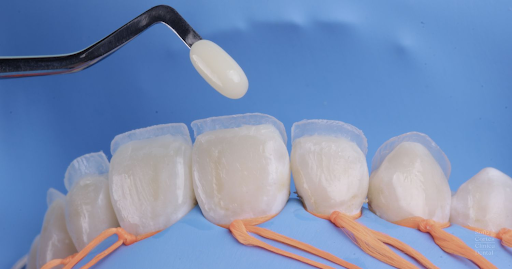
Veneers can be an excellent treatment. However, they are not always the right treatment.
In fact, some of the most important decisions we make in cosmetic dentistry involve recognising when a patient would benefit more from alternatives to dental veneers.
At SMITA, we often meet patients who have already been offered six, eight or ten veneers elsewhere. Sometimes that plan makes perfect sense. In other cases, however, we discover that the teeth are healthy and that the main concern could be solved with whitening, orthodontics, gum treatment or a few small additions of composite.
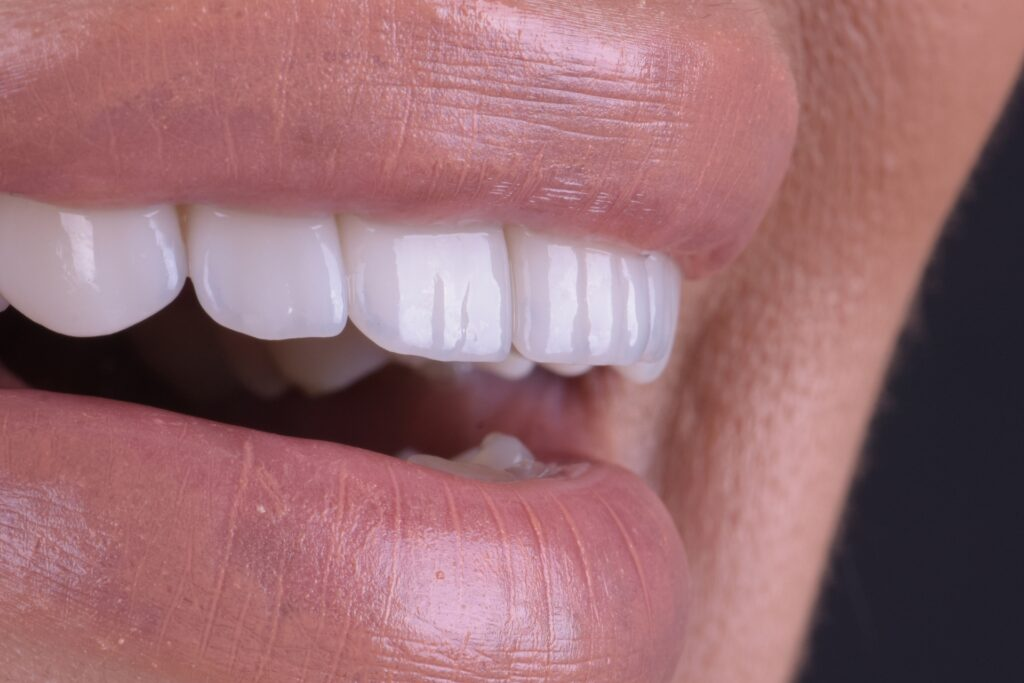
Therefore, our first question is not:
“How many veneers do you need?”
Instead, we ask:
“What exactly do you want to improve, and what is causing it?”
That difference is fundamental.
Our aim is not to avoid veneers. It is to use them when they genuinely add value and to consider more conservative options when they do not.
Wanting a better smile does not automatically mean you need veneers
Today, veneers are everywhere.
We see dramatic smile transformations on social media, in advertising and in before-and-after photographs. As a result, many people have started to associate cosmetic dentistry almost entirely with veneers.
A patient may say:
“My teeth are too yellow.”
“My smile looks uneven.”
“My teeth are too small.”
“I have spaces.”
“I want a more attractive smile.”
Yet each of these concerns can have several different causes.
For example, a tooth can appear small because the tooth itself is genuinely narrow. However, it can also look small because too much of it is covered by gum.
Likewise, a smile can appear uneven because of tooth shape. On the other hand, the real problem may be tooth position.
Therefore, before choosing a treatment, we need to understand the cause.
Only then can we decide whether veneers, whitening, Invisalign, composite bonding, gum treatment or another option makes the most sense.
At SMITA, diagnosis comes before treatment

We do not believe that cosmetic dentistry should begin with a product.
Instead, it should begin with a diagnosis.
Before recommending treatment, we assess factors such as:
Tooth health and existing restorations
Gum health
Tooth position
Colour
Shape and proportions
Wear
Spaces
Smile width
Gum display
Bite and function
The relationship between the teeth, lips and face
Most importantly, we also discuss what the patient actually wants to change.
After all, two people with very similar teeth may want completely different results.
One may want a significant transformation.
The other may simply want a fresher, brighter version of their natural smile.
Therefore, a personalised treatment plan cannot start with:
“Ten veneers.”
It should start with:
“What is the smallest and most logical treatment that can achieve the result this person wants?”
Alternative 1: whitening when the real problem is colour
One of the simplest alternatives to dental veneers is professional whitening.
Imagine a patient with healthy teeth, good alignment and attractive proportions.
The only concern is colour.
Perhaps the teeth look yellow.
Maybe they have darkened over time.
In this situation, covering healthy teeth simply to make them lighter may not be necessary.
Instead, professional tooth whitening can improve the natural colour while leaving the tooth shape untouched.
The American Dental Association describes tooth whitening as a less-invasive aesthetic treatment and notes that professional in-office and dentist-supervised home whitening are established options for improving tooth colour.
At SMITA, whitening often also forms part of a wider aesthetic plan. In fact, when we later intend to add composite or ceramic restorations, improving the natural tooth colour first can help us choose a better final shade.
However, whitening does have limits.
Some deep internal colour changes may not respond enough. Existing crowns and tooth-coloured restorations also do not whiten like natural teeth.
Therefore, we assess the cause of the colour problem before deciding what to do.
Suggested external link: American Dental Association – Tooth Whitening
Suggested internal link: SMITA article on Philips Zoom whitening
Alternative 2: Invisalign when the real problem is tooth position
This is one of the most important decisions in conservative cosmetic dentistry.
A tooth may be:
Rotated
Crowded
Tilted forwards
Positioned too far backwards
At a different angle from the neighbouring teeth
Technically, we can sometimes use veneers to create the visual appearance of straighter teeth.
However, there is a problem.
If a tooth sits too far forwards, creating the desired shape with a veneer may require us to remove healthy enamel first.
Therefore, we have to ask:
Why reduce a healthy tooth if we can move it instead?
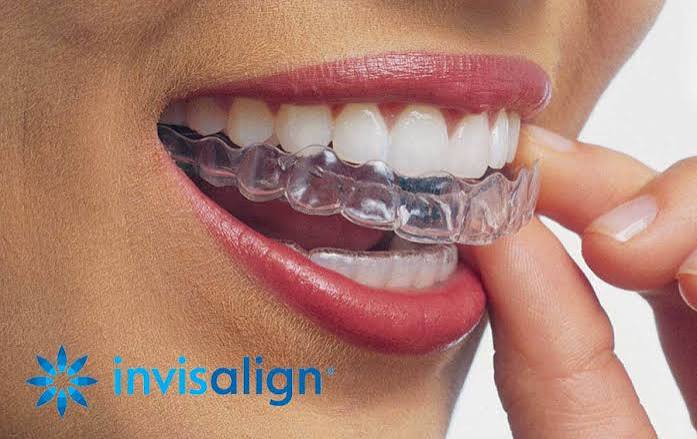
In selected cases, Invisalign can place the tooth in a more favourable position before any restorative treatment.
As a result, we may need less composite or ceramic afterwards.
Sometimes we need fewer veneers.
Occasionally, we discover that we do not need veneers at all.
This is one of the clearest examples of why alternatives to dental veneers can actually lead to a more conservative final result.
At SMITA, our approach is to define where the teeth should ideally be before deciding how much we need to change their shape. This is also why orthodontics and smile design are often planned together rather than as unrelated treatments.
Suggested internal link: Invisalign before veneers: when it makes treatment more conservative
Moving a tooth can sometimes be more conservative than reshaping it
- Real SMITA case: Invisalign and 2 only ceramic veneers
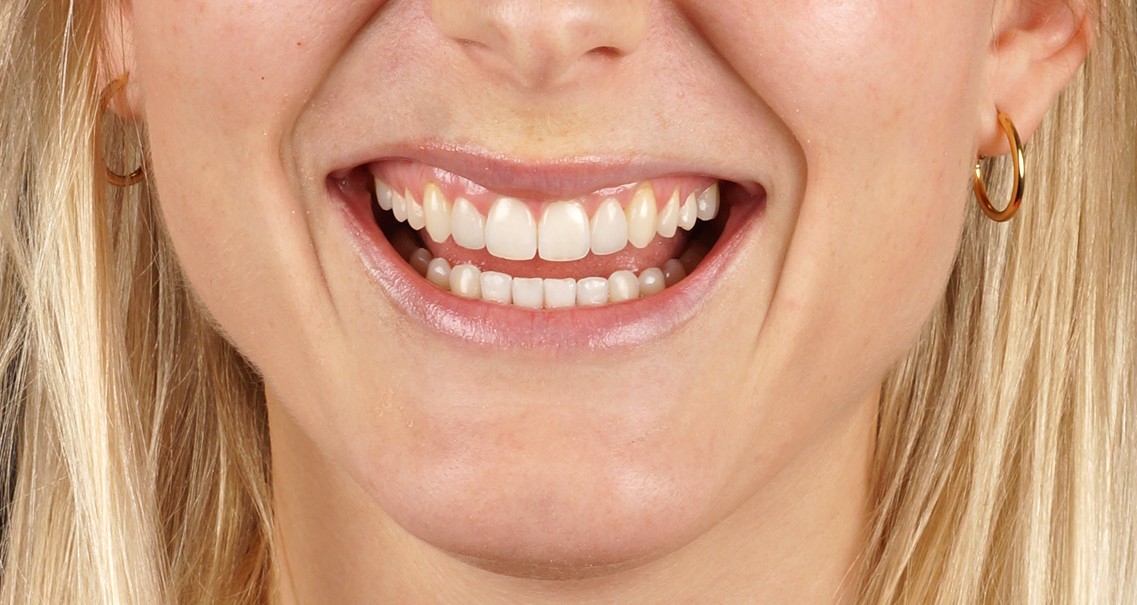
This concept deserves particular attention.
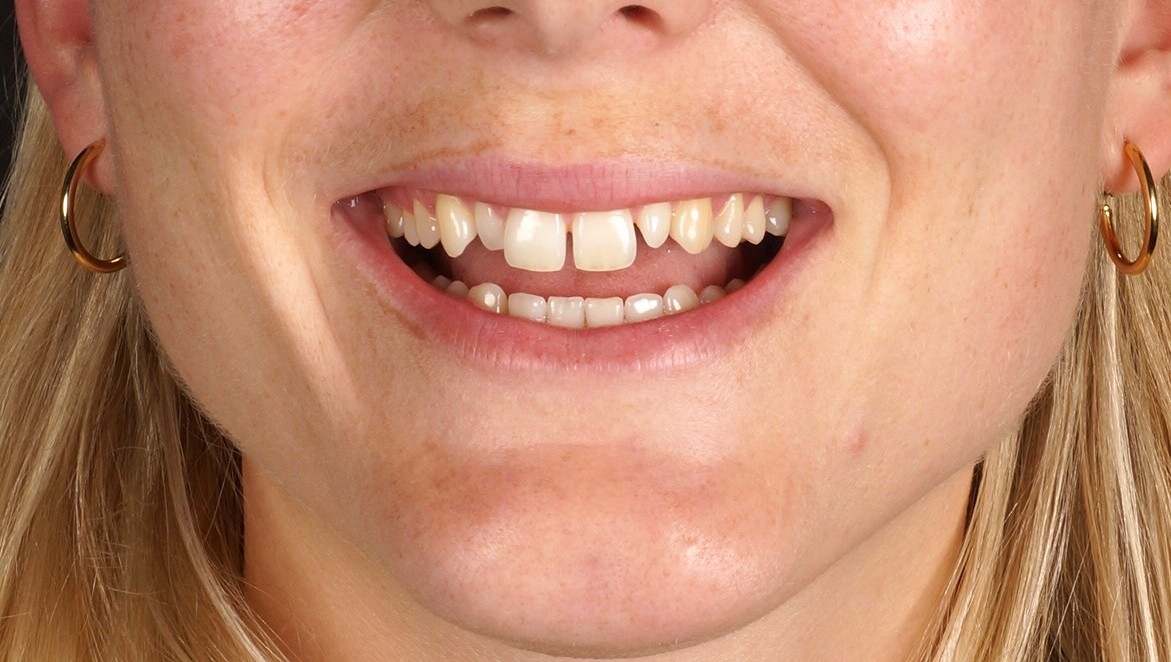
Imagine an upper front tooth that is rotated.
From the front, it may look narrower than the tooth next to it.
We could try to make it appear wider with composite or ceramic. However, adding material to one side while reducing another may create unnecessary changes in volume.
If we first correct the rotation, the tooth may suddenly look much more symmetrical.
At that point, we may only need a tiny composite addition.
Or perhaps nothing at all.
Therefore, orthodontics is not necessarily “extra treatment”.
Sometimes it allows us to do less irreversible treatment later.
Alternative 3: small composite additions instead of full veneers
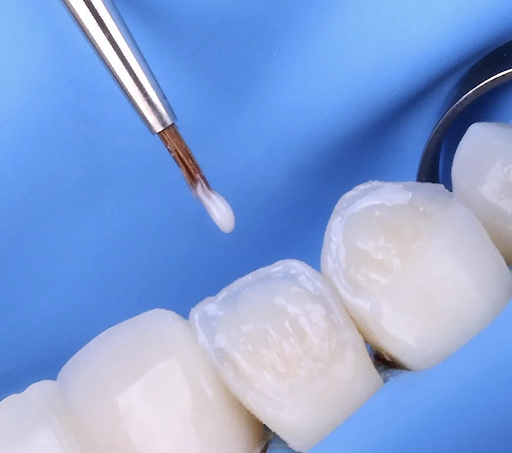
Another of our favourite alternatives to dental veneers is additive composite bonding.
Not every aesthetic problem affects an entire tooth.
For example, a patient may have:
A small chipped edge
A narrow lateral incisor
A minor gap
One uneven corner
A slightly short tooth
A small asymmetry
In such cases, covering the whole front surface may be unnecessary.
Instead, we can add composite only where structure is missing.
This is a very different philosophy.
Rather than asking:
“How can we cover this tooth?”
we ask:
“Where exactly do we need to add material?”
At SMITA, our aesthetic composite treatments are designed to be minimally invasive. We can layer the material directly onto the tooth, shape it carefully and polish it to integrate with the surrounding enamel.
Moreover, composite has another important advantage: we can repair, adjust or add to it later.
Therefore, when the required change is small and mainly additive, composite can be one of the most conservative options available.
Suggested internal link: Composite vs porcelain veneers
Suggested internal link: Improve your smile without shaving your teeth
Alternative 4: treating the gums instead of covering the teeth
- Real SMITA case: Gum correction + Philips Zoom whitening + Composite restorations
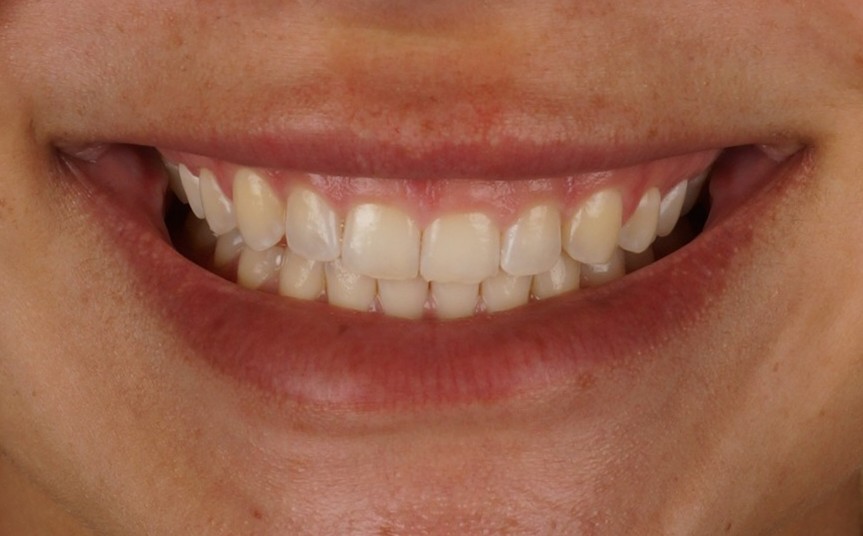
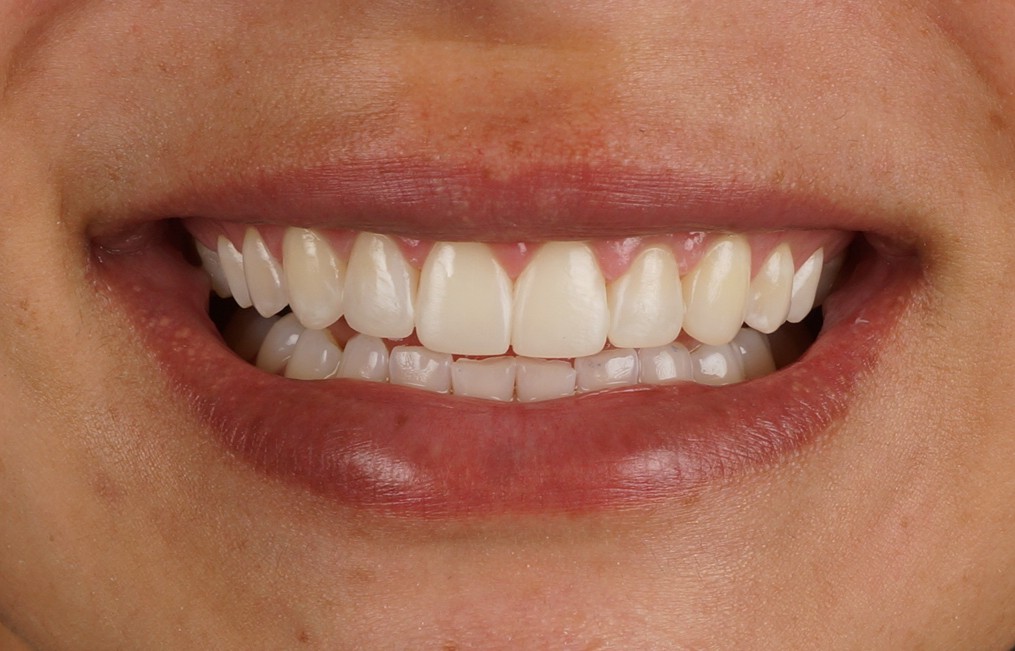
Sometimes patients believe their teeth are too short.
However, when we study the smile, the teeth themselves may actually have good dimensions.
The problem may be the gum.
For example, we may find:
Excess gum covering the tooth
Uneven gum levels
Too much gingiva visible when smiling
Different proportions between one side and the other
In selected cases, reshaping the gum can reveal more of the natural tooth and completely change the proportions of the smile.
As a result, veneers may become unnecessary.
In other situations, gum treatment reduces how much restorative work we need afterwards.
Current literature on aesthetic crown lengthening also emphasises the importance of identifying the underlying cause of the aesthetic concern and coordinating periodontal and restorative planning rather than applying the same solution to every patient.
This is exactly why we do not design teeth and gums separately.
They form one visual composition.
Suggested external link: PubMed – aesthetic crown lengthening and treatment planning
Suggested internal link: Gum aesthetics and Digital Smile Design
Sometimes several small treatments work better than one big treatment
There is a common misconception that combining treatments means making dentistry more complicated.
Sometimes the opposite is true.
Imagine a patient with:
Slightly dark teeth
A little excess gum display
Two slightly short front teeth
One minor asymmetry
One option could be to cover several teeth with veneers.
However, another option might be:
Professional whitening
A small correction of the gum line
Two additive composite restorations
The final aesthetic change can still be very significant.
Yet we may have preserved almost all of the natural tooth structure.
At SMITA, we have real cases in which gum treatment, whitening and additive composite have produced a major smile transformation without aggressive tooth preparation.
Therefore, conservative dentistry does not necessarily mean doing only one thing.
It means doing only what each part of the smile actually needs.
Why Digital Smile Design can help us avoid veneers
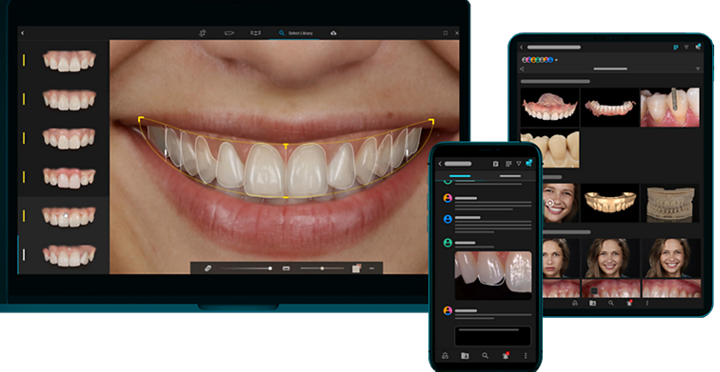
Digital Smile Design is sometimes associated with planning veneers.
However, that is only one possible outcome.
For us, one of the most valuable uses of digital planning is identifying alternatives to dental veneers before we perform anything irreversible.
First, we study the face.
Then, we assess the lips, smile line, teeth, gums and proportions.
Afterwards, we can use photography, 3D scanning and digital design to explore possible changes.
If appropriate, we can also transfer the design into the mouth with a mock-up.
At that stage, we can ask:
Do we really need veneers?
Could whitening solve the colour?
Could Invisalign improve the position?
Could a small amount of composite correct the shape?
Would changing the gum line improve the proportions?
Do we need to treat eight teeth, or only two?
The purpose of technology should not be to justify more dentistry.
Instead, better planning should help us do less unnecessary dentistry. This principle is central to the way SMITA uses smile simulation and Digital Smile Design.
Suggested internal link: Smile simulation: see and test your treatment before starting
Preserving healthy enamel changes the long-term equation
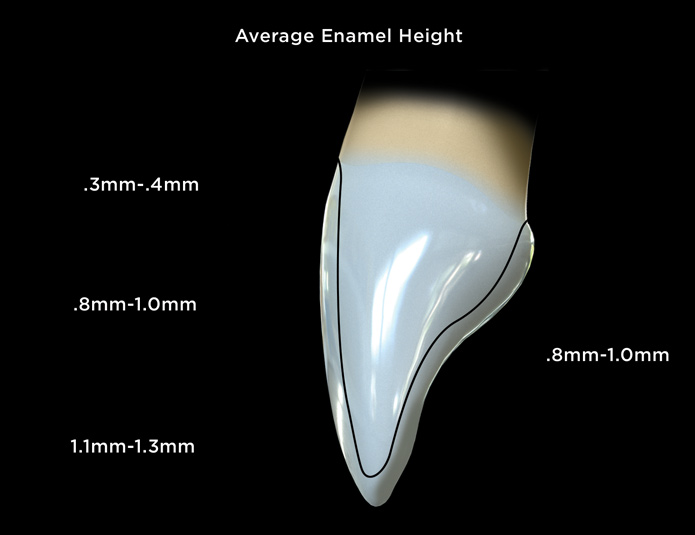
There is another reason why we take alternatives to dental veneers seriously.
Healthy enamel is valuable.
Once tooth structure has been removed, we cannot grow it back.
Furthermore, enamel is also an excellent surface for adhesive dentistry.
A 2025 study following ceramic veneers for up to 15 years found that greater dentine exposure was associated with a higher risk of failure. The authors concluded that preserving enamel is important for optimising the long-term outcome of bonded ceramic veneers.
This does not mean that teeth can never be prepared.
Sometimes minimal preparation is necessary to create the correct shape, thickness, margin and final result.
However, the important question is:
How much preparation is actually necessary?
If a tooth is crowded and sits too far forwards, aggressively reducing it simply to create visual alignment may sacrifice healthy enamel that could have been preserved through orthodontic movement.
By contrast, a naturally small tooth may be an excellent candidate for an additive restoration because we need to add rather than remove structure.
Therefore, the same material can be conservative in one patient and unnecessarily aggressive in another.
The difference is diagnosis.
Suggested external link: PubMed – ceramic veneer survival and enamel preservation
So when DO we recommend veneers?
- Real SMITA case: E.max veneers
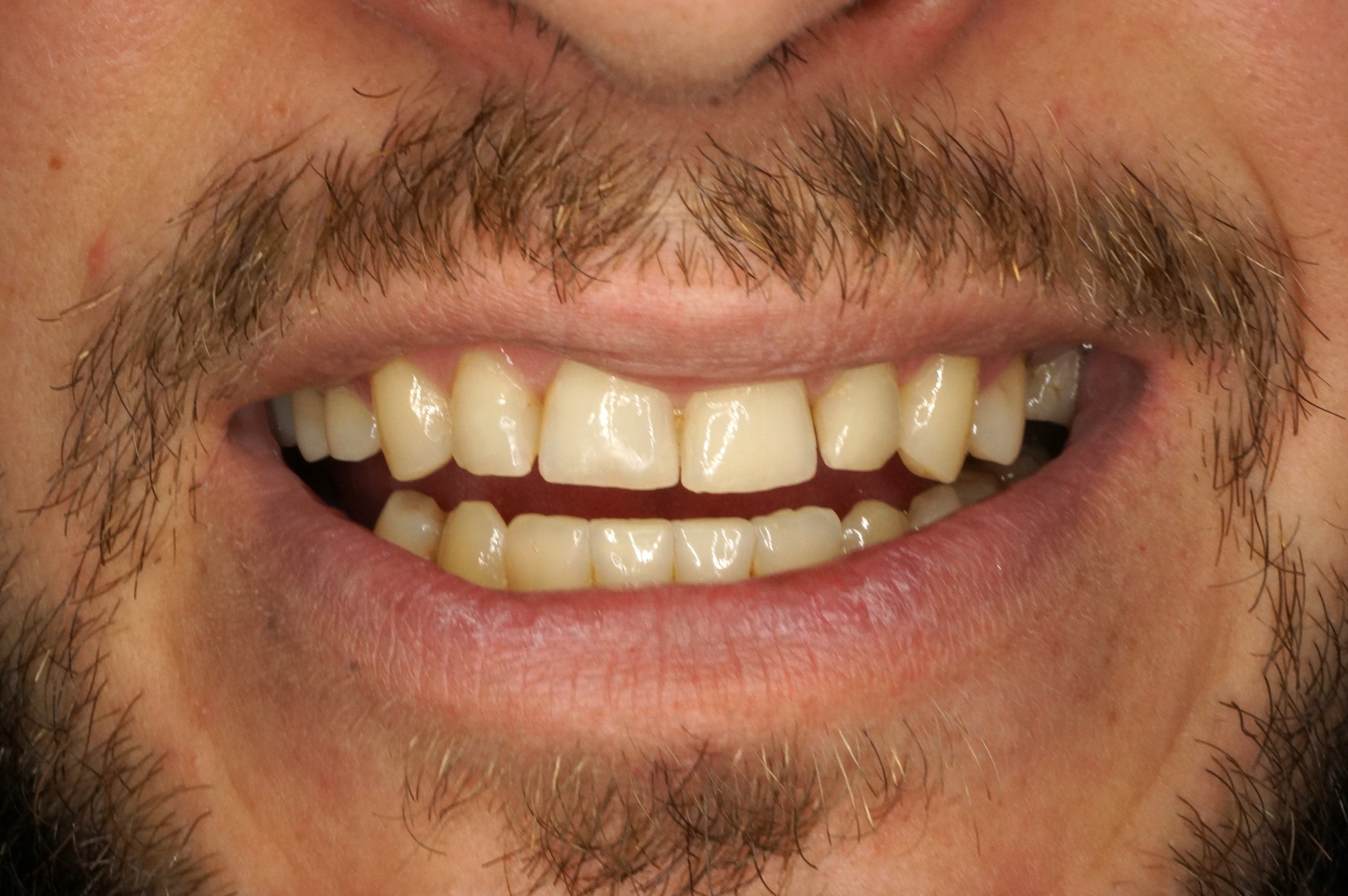
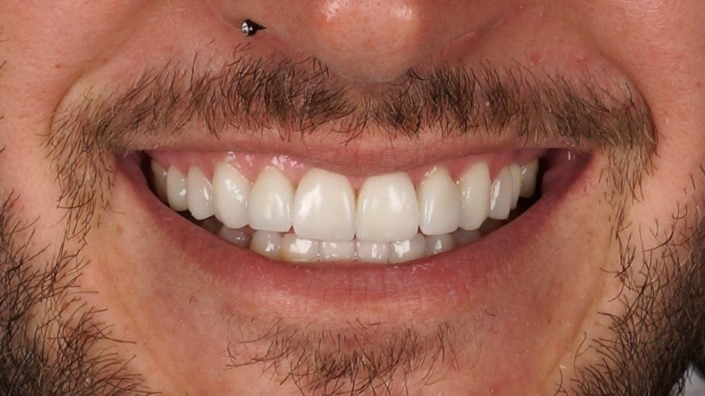
This article is not against veneers.
Quite the opposite.
When veneers are correctly indicated, they can be one of the most effective and elegant treatments in cosmetic dentistry.
For example, we may recommend them when teeth are:
Naturally very small
Structurally altered
Significantly worn
Fractured
Affected by old or extensive restorations
Disproportionate in shape
Affected by colour changes that cannot be improved enough with whitening
In these cases, the restoration can replace or add something that is genuinely missing.
In addition, ceramic veneers can offer excellent optical stability and long-term aesthetic performance when carefully planned and bonded.
Therefore, the goal is not to avoid veneers at all costs.
The goal is to know when veneers actually improve the biological and aesthetic situation rather than simply covering it.
A patient asking for veneers may leave without veneers — and that can be a good outcome
This happens more often than people might expect.
Someone may book an appointment because they believe veneers are the only way to improve their smile.
After the assessment, however, we may recommend whitening and Invisalign.
Another patient may need gum correction and a few composite additions.
Someone else may genuinely need six ceramic veneers.
All three treatment plans can be correct.
This is what personalised dentistry means.
We do not believe every patient should receive the same smile or the same treatment.
Therefore, the consultation should not be a sales conversation about veneers.
It should be a diagnostic conversation about the smile.
Why the fastest solution is not always the most conservative solution
Patients often ask how quickly a smile can be changed.
It is an understandable question.
Veneers can sometimes create a dramatic visual result quickly.
However, speed should not be the only factor.
If a few months of orthodontic treatment allow us to preserve a large amount of healthy enamel, waiting may be worthwhile.
Likewise, if whitening can improve the natural colour before restorations, that extra phase can reduce the opacity or extent of future restorative work.
Therefore, we also consider the long-term biological cost of each option.
Conservative treatment is not necessarily the shortest treatment.
It is the treatment that achieves the desired result while respecting healthy tissue as much as reasonably possible.
There is no single best alternative to veneers
Patients often ask:
“What is the best alternative to veneers?”
However, there is no universal answer.
The best alternatives to dental veneers depend on what needs to change.
If the problem is colour, whitening may be best.
When tooth position is the issue, orthodontics may be more logical.
For small shape changes, composite can be enough.
If gum levels are the problem, periodontal treatment may solve it.
In many cases, the best plan combines two or three of these treatments.
Therefore, we do not choose a treatment because it is fashionable.
We choose it because it solves a specific problem.
Our philosophy at SMITA: first design, then decide how little we need to do
At SMITA Advanced Smile Design, our starting point is not:
Composite?
Porcelain?
Invisalign?
Whitening?
Instead, we begin with the final smile.
What should the proportions look like?
How should the teeth relate to the lips?
What needs to change?
What should remain untouched?
Once we understand the desired result, we can decide how to achieve it.
Sometimes veneers are part of that plan.
At other times, alternatives to dental veneers allow us to achieve the same aesthetic goal while preserving more natural tooth structure.
That is why we prefer to make irreversible decisions as late as possible.
First, we analyse.
Then, we design.
When useful, we simulate.
If necessary, we move teeth.
We improve the colour when appropriate.
We adjust the gums if they are part of the problem.
Finally, we restore only what still needs to be restored.
Because good cosmetic dentistry is not about doing the maximum amount of dentistry.
It is about achieving the maximum result with the minimum necessary intervention.

Frequently Asked Questions
What are the main alternatives to dental veneers?
The main alternatives to dental veneers include professional whitening, Invisalign or other orthodontic treatment, additive composite bonding and aesthetic gum treatment. The best option depends on whether the main concern is colour, position, tooth shape, proportions or the gums.
When are veneers not recommended?
Veneers may not be the first choice when healthy teeth already have good proportions and the main problem could be corrected more conservatively. For example, yellow teeth may respond to whitening, while crowded teeth may benefit more from orthodontics.
Can I improve my smile without veneers?
Yes. Many patients can achieve a major improvement through whitening, orthodontics, composite bonding, gum treatment or a combination of these approaches.
Can Invisalign replace veneers?
Sometimes. If the main concern is tooth position, Invisalign may correct the problem without restorative treatment. However, orthodontics does not change tooth colour, intrinsic shape or lost tooth structure, so some patients may still benefit from composite or veneers afterwards.
Can composite bonding replace veneers?
In selected cases, yes. Small chips, spaces, narrow teeth or minor shape problems may be corrected with small additive composite restorations instead of full veneers.
Can whitening replace veneers?
If the main concern is colour and the teeth already have a good shape and position, professional whitening may be sufficient. However, some deep colour changes may not respond enough and may require another approach.
Can gum treatment improve my smile without veneers?
Yes. When teeth look short because of excess gum tissue or uneven gum margins, improving the gum architecture can significantly change the smile and may reduce or eliminate the need for veneers.
Why is preserving enamel so important?
Enamel is healthy natural tooth structure and provides an excellent surface for bonding. In addition, research suggests that ceramic veneers have a better prognosis when more enamel is preserved.
Are veneers bad for healthy teeth?
Not necessarily. Properly planned veneers can be very conservative. However, unnecessary or aggressive removal of healthy enamel should be avoided when another treatment could achieve the desired result more conservatively.
How do I know whether I need veneers or an alternative?
A complete aesthetic assessment is necessary. We need to evaluate tooth health, colour, position, shape, gums, bite, facial proportions and your desired result before deciding which treatment makes the most sense.
More about the SMITA team:
Book your appointment at SMITA: