One of the questions that worries patients most before having veneers is:
“Do veneers damage teeth?”
And there is an even more direct version that appears frequently on Google:
“Do veneers rot teeth?”
The correct answer is not simply yes or no.
A veneer that is properly indicated, conservatively designed, bonded under a strict protocol and correctly maintained should not cause the tooth to deteriorate simply because it is covered by a veneer.

But we also cannot say that all veneers are the same.
The prognosis depends greatly on:
How much healthy tooth structure we preserve
What surface we are bonding to
Which material we use
Which adhesive system we use
How the ceramic or composite surface is treated
Whether we can isolate the field correctly
The precision of the margins
The bite
The patient’s hygiene
And maintenance over the following years
For us, the difference between aggressive aesthetic dentistry and conservative aesthetic dentistry starts precisely here:
how much natural tooth structure we manage to preserve before placing the restoration.
Enamel is one of our greatest allies
When we talk about veneers, preserving enamel is not only a philosophical issue.
It is directly related to bonding.
Enamel is a highly mineralised tissue and provides an exceptionally favourable substrate for adhesive dentistry.
Available evidence shows that ceramic veneers bonded predominantly to enamel perform better than those where there is significant dentine exposure. A recent review found a higher risk of failure when the bonding substrate had severe dentine exposure, reinforcing the importance of preserving enamel whenever clinically possible. (pubmed.ncbi.nlm.nih.gov)
This explains an essential part of our philosophy at SMITA:
we do not want to remove healthy enamel unless there is a clinical reason to do so.
Because we are not only preserving biological tissue.
We are also preserving one of the best substrates we have for achieving a stable bond.
So what does it really mean to “bond” a veneer to a tooth?
A veneer is not placed using conventional “glue”.
Adhesive dentistry works through a combination of micromechanical and chemical processes.
And this is where there is an important difference between composite veneers and ceramic veneers.
Although both are bonded to the tooth, the process is not exactly the same.
Composite bonding: building directly onto the tooth
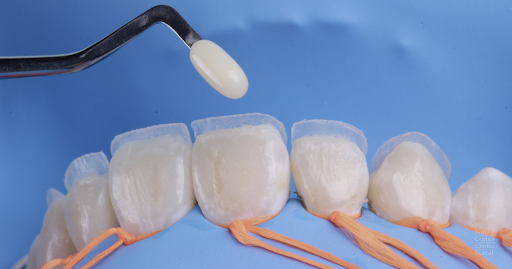
With a direct composite veneer, there is no ceramic restoration fabricated outside the mouth.
The composite itself is built directly onto the tooth.
First, we prepare the dental surface to create the appropriate conditions for bonding.
On enamel, phosphoric acid is commonly used to create an extremely fine surface microstructure.
We are not creating visible “holes” in the tooth.
We are creating microscopic porosities.
Then we apply the adhesive system.
The resin in the adhesive penetrates this microstructure and, once light-cured, creates a very strong micromechanical bond with the enamel.
The composite is then added over that adhesive layer.
The resin monomers in the composite and adhesive system polymerise to create a continuous interface.
In simple terms:
condition the enamel → infiltrate the adhesive → add composite → polymerise the system.
And what happens when dentine is involved?
Dentine is different.
It contains more organic material and water and has a much more complex structure than enamel.
This makes bonding to dentine more technique-sensitive.
Modern adhesive systems create what is known as a hybrid layer, where resin components penetrate into the conditioned dentine structure.
In addition, some adhesives contain functional monomers capable of forming chemical interactions with hydroxyapatite.
One of the best-known examples is 10-MDP.
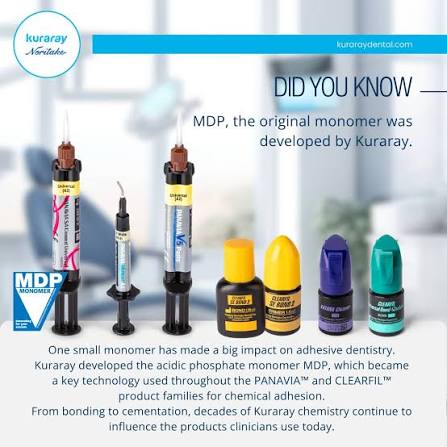
At SMITA, we use CLEARFIL adhesive systems from Kuraray. The CLEARFIL family uses chemistry based on 10-MDP; Kuraray describes this monomer as being able to establish a chemical bond with hydroxyapatite while also contributing to bonding to enamel and dentine. (kuraraynoritake.com)
This may sound like an extremely technical detail.
But it actually explains something very important:
the quality of a veneer does not depend only on the composite you see on the outside.
It also depends on everything happening microscopically underneath.
The composite we use also matters
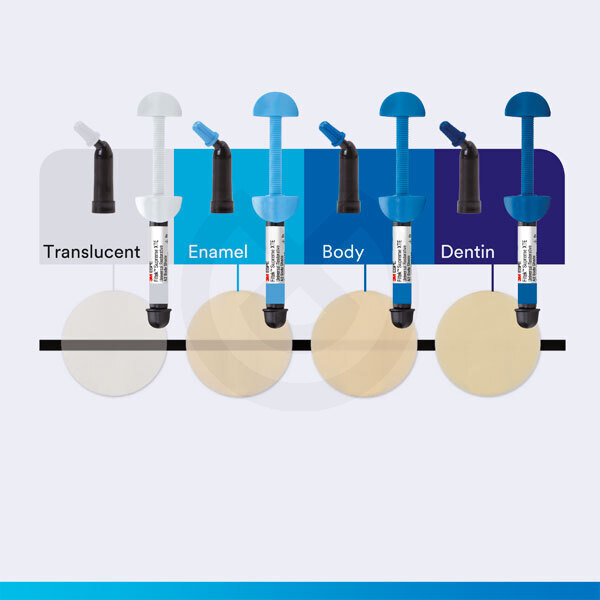
For our aesthetic rehabilitations, we use high-end composites such as Filtek Supreme.
The Filtek Supreme family uses nanotechnology and is designed to provide aesthetic properties, different opacity levels and good polish retention, which is especially important in anterior restorations. (solventum.com)
But even an excellent composite does not automatically produce an excellent veneer.
The final result depends on:
Diagnosis
Isolation
Adhesive
Layering technique
Polymerisation
Anatomy
Bite
Finishing
And polishing
At SMITA, we work with composite in layers when we want to reproduce different optical properties of the natural tooth, which is also part of our minimally invasive aesthetic rehabilitation protocol.
Why does composite require more maintenance?

This is one of the main differences compared with ceramic.
Composite is a resin-based material.
Over the years, it can undergo:
Surface wear
Progressive loss of gloss
Changes in texture
Pigmentation
Minor marginal defects
Wear of incisal edges
Changes in the transition between composite and natural tooth
A systematic review specifically evaluating composite veneers found that the most frequent complications included surface roughness, colour mismatch and marginal staining. (pubmed.ncbi.nlm.nih.gov)
This does not necessarily mean that the veneer has “failed”.
One of the major advantages of composite is precisely that we can:
Polish it
Retouch it
Add material
Repair a small fracture
Modify the shape
Renew specific areas without replacing the entire restoration
This is why at SMITA we recommend periodic maintenance and polishing, usually annually, for composite treatments.
There is no exact year when a composite veneer “expires”.
In some patients, it can remain in good condition for many years with minor maintenance.
In others, small repairs or corrections may be needed sooner.
And after several years, there may come a point when renewing part or all of the restoration becomes more logical.
Long-term studies on anterior composite restorations support this characteristic: they can have good survival, but monitoring, repairs and eventual replacement should be expected over time. (pubmed.ncbi.nlm.nih.gov)
Bonding ceramic veneers: a different interface
A ceramic veneer works differently.
The restoration is first fabricated outside the mouth.
It may be, for example:
Feldspathic porcelain
Lithium disilicate IPS e.max
We then need to bond two different surfaces:
ceramic + tooth.
And each one requires its own specific treatment.
First, we treat the internal surface of the ceramic
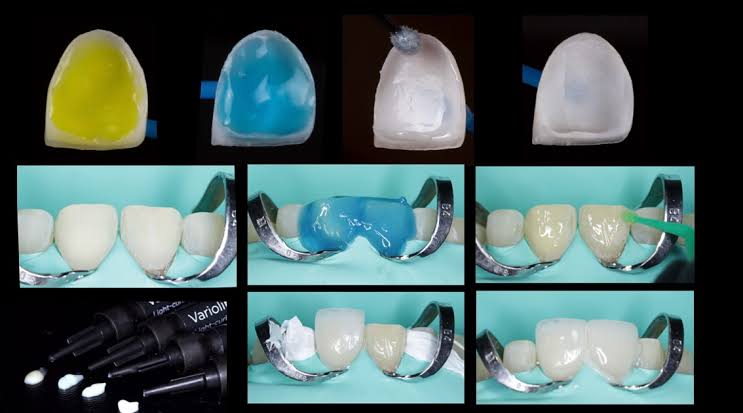
Glass ceramics such as feldspathic porcelain and lithium disilicate contain a glass phase that can be conditioned.
A specific protocol is generally used, including acid treatment of the internal surface followed by a silane agent.
The conditioning creates a microscopic retentive surface.
Then the silane comes into play.
Silane works as a kind of molecular bridge.
One part of the molecule interacts with the silica-rich ceramic surface.
The other can take part in polymerisation with the resin cement.
This allows us to chemically connect:
ceramic → silane → resin cement.
And on the other side we have the tooth
The tooth also receives its adhesive protocol.
When we are able to keep the preparation mainly within enamel, the bonding conditions are particularly favourable.
A specific resin cement is then used to bond the veneer to the tooth.
At SMITA, we use high-quality cementation materials such as Variolink Esthetic by Ivoclar for selected ceramic treatments.
Variolink Esthetic is specifically indicated for the adhesive cementation of restorations such as glass-ceramic and lithium-disilicate veneers, and it includes light-cured versions designed for thin and translucent restorations. (ivoclar.com)
This gives us another adhesive chain:
conditioned ceramic → silane → resin cement → adhesive → enamel/dentine.
Every link matters.
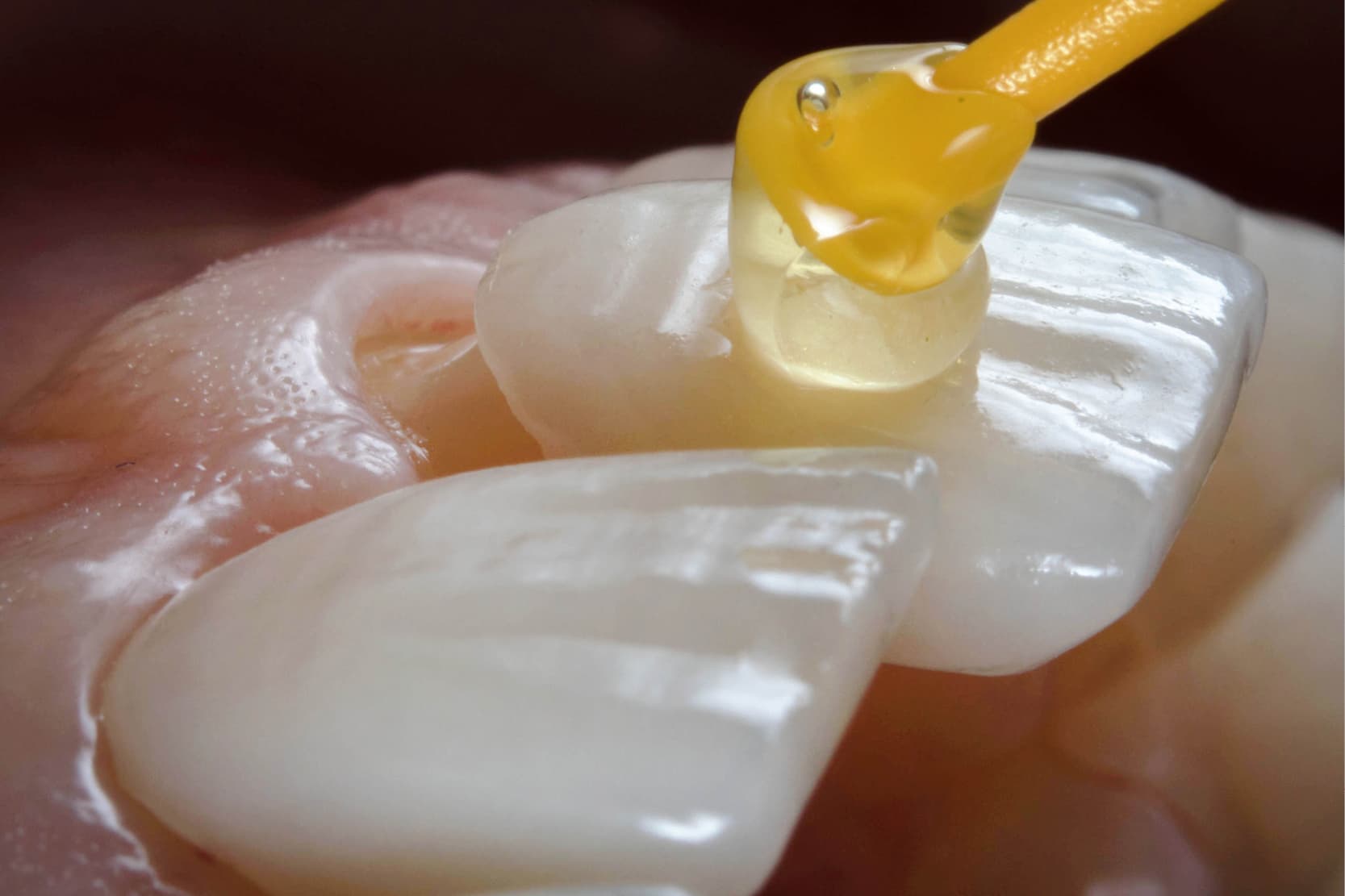
This is why a ceramic veneer is not simply “glued on”
This concept changes the way we understand a veneer.
An extremely thin ceramic veneer may appear fragile when held before cementation.
But once it is correctly bonded to enamel, it forms a much stronger mechanical complex together with the tooth.
Classical and current literature on ceramic veneers has shown good long-term outcomes when enamel is preserved and adhesive protocols are correctly performed. (pubmed.ncbi.nlm.nih.gov)
This is why, conceptually, in selected cases we like to think of a ceramic veneer as an adhesive laminate of the tooth.
It does not replace the tooth.
It does not turn the tooth into something completely artificial.
It adds a very thin ceramic layer that becomes intimately integrated through bonding.
But for this concept to work properly, one thing is essential:
we must not unnecessarily destroy the substrate we are trying to bond to.
Why we do not support aggressive tooth reduction to “straighten” crowded teeth
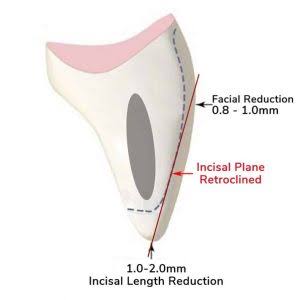
This is probably one of the points that most clearly defines our philosophy.
Imagine completely healthy but crowded teeth.
One incisor is positioned forwards.
Another is rotated.
Another is slightly behind the others.
One option would be to try to create the appearance of alignment using veneers alone.
But if doing so requires removing a large amount of healthy enamel, from our perspective the biological cost may be too high.
In these cases, we ask:
Can we move the tooth first and preserve its structure?
This is why we use orthodontics — often Invisalign — as part of many smile design treatments.
We move the tooth into a more favourable position.
Then, if a restoration is still needed, it can be performed in a much more additive and conservative way.
The evidence on veneers explains exactly why this matters: restorations bonded predominantly to enamel have a better adhesive prognosis than those where preparation exposes a large amount of dentine. (pubmed.ncbi.nlm.nih.gov)
For us, removing healthy enamel simply to camouflage a tooth position that could be corrected orthodontically can represent unnecessarily aggressive treatment.
Isolation: one of the details the patient never sees
There is another factor that can make a major difference in the quality of adhesive treatment.
Isolation.
When we bond a veneer or place a composite restoration, we want to control:
Saliva
Blood
Gingival fluid
Moisture
The tongue
Soft tissues
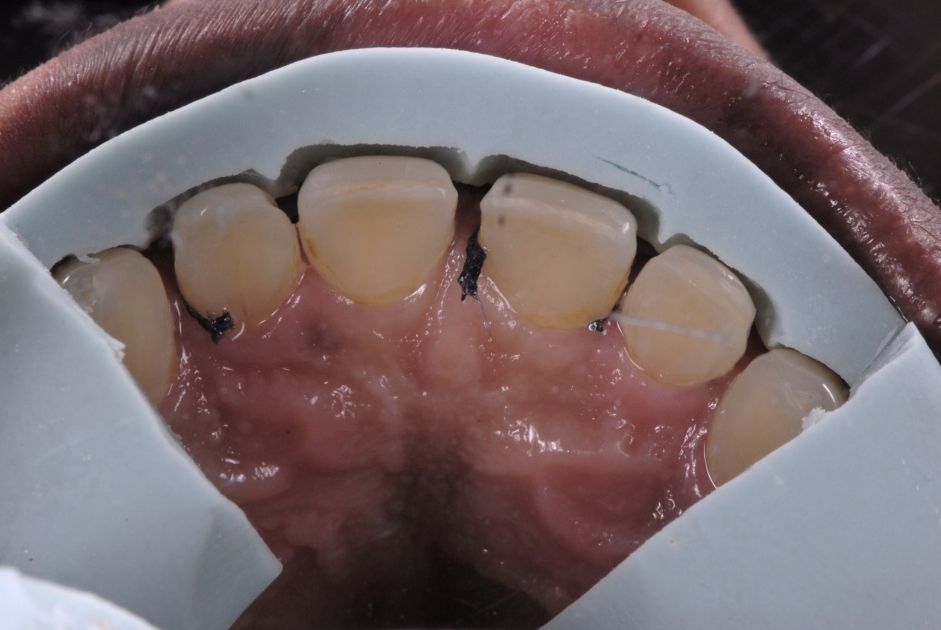
In many situations, we use a rubber dam or absolute isolation techniques.
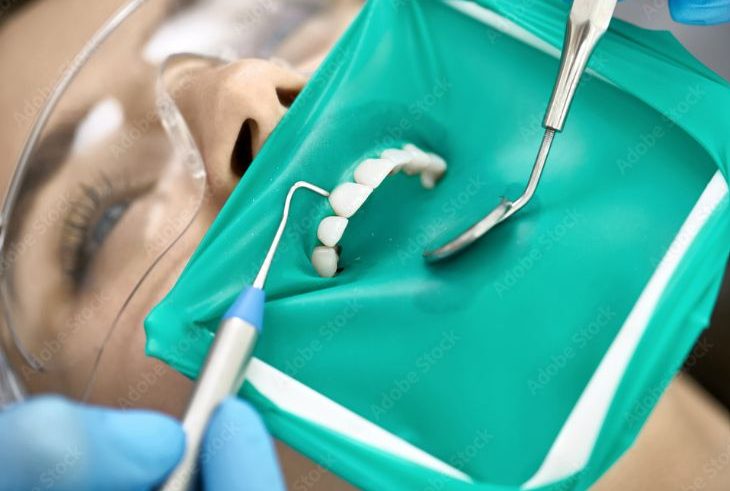
From the outside, it may look like nothing more than a sheet placed around the teeth.
From an adhesive point of view, it is much more important than that.
Contamination of the surface during certain stages of the procedure can reduce bond quality. Clinical studies have shown that rubber dam isolation can improve enamel bond strength, while recent reviews confirm the importance of contamination control in adhesive dentistry. (pubmed.ncbi.nlm.nih.gov)
Even blood contamination can reduce bond strength to dentine, and the original conditions are not always fully recovered simply by cleaning afterwards. (pubmed.ncbi.nlm.nih.gov)
This is why, for us:
isolation is not an optional detail of the procedure.
It is part of treatment quality.
So can a veneer come off?
Yes.
No dental restoration carries zero risk.
A veneer may develop complications such as:
Debonding
Fracture
Chipping
Marginal staining
Periodontal problems
Secondary caries
But these risks need to be placed in context.
A systematic review analysing approximately 6,500 ceramic veneers estimated cumulative survival at around 95.5% at 10 years. Debonding and secondary caries were relatively infrequent complications in the studies analysed. (pubmed.ncbi.nlm.nih.gov)
A more recent review also found high long-term survival rates for both feldspathic porcelain and lithium disilicate veneers. (pubmed.ncbi.nlm.nih.gov)
This does not mean:
“A veneer lasts 10 years.”
Nor does it mean:
“A veneer will last 20 years.”
It means that ceramic veneers that are correctly indicated and properly executed can have very high long-term clinical survival.
Some veneers remain successful for far longer than ten years.
But we should not promise an exact lifespan for an individual patient.
Does ceramic also need maintenance?
Yes.
But the type of maintenance is different from composite.
Ceramic has excellent colour and surface stability and is much less prone than composite to losing gloss, staining or requiring frequent repolishing.
This is why we generally do not need to perform the same type of annual aesthetic surface maintenance that we often perform on composite veneers.
But this does not mean we can forget about them.
We still need to monitor:
The margins
The gums
The bite
The bonding interface
The cement
The contacts
Periodontal health
Hygiene
And the tissues around the restoration.
A veneer can still look perfectly beautiful while the surrounding tissue begins to develop a problem.
And this point is fundamental.
The veneer may still be there in 15 or 20 years. But what about the gum?
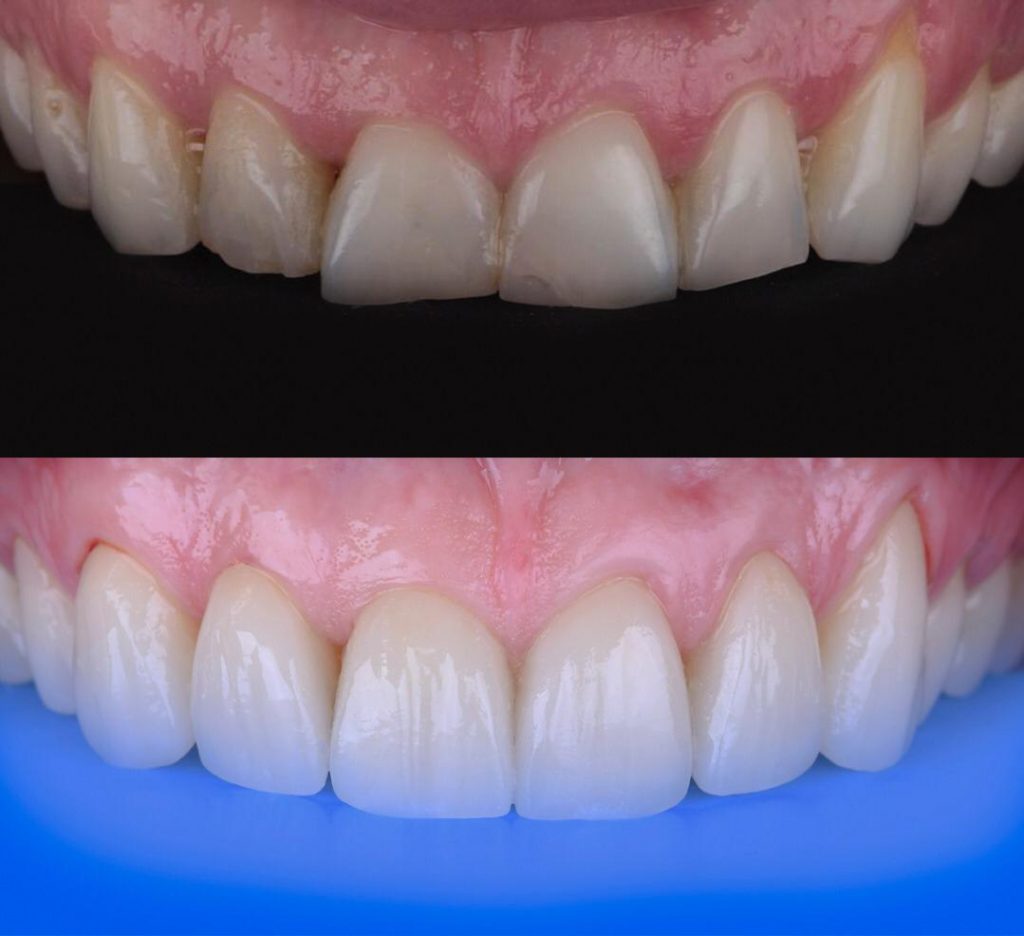
This is a question we often ask when discussing longevity.
We can create an extremely precise restoration.
We can use excellent ceramic.
We can perform an impeccable bonding procedure.
But the gum is still living tissue.
If plaque accumulates around the margins for years, the gums can become inflamed.
They can bleed.
Periodontal support can be lost.
Recession may occur.
And then the aesthetics of a technically perfect veneer can change because the tissue around it has changed.
This is why the longevity of a smile depends not only on the longevity of the porcelain.
It depends on the longevity of:
The tooth
The gum
The bone
The bite
And the patient’s habits
A 2024 systematic review found that veneers can coexist with good periodontal health when preparation, cementation and maintenance are appropriate, although results depend on multiple factors and the available studies are heterogeneous. (pubmed.ncbi.nlm.nih.gov)
Hygiene around veneers must be excellent
A patient with veneers needs to maintain:
Meticulous brushing
Daily interdental cleaning
Regular professional hygiene appointments
Periodontal reviews
Bleeding control
Plaque control
Individualised maintenance
Not because veneers automatically “attract” bacteria.
But because there is still an interface between:
Tooth
Restoration
Gum
And that area must remain clean.
We also need to completely remove excess cement during cementation. Excess resin around the margin can make hygiene more difficult and contribute to biological problems. (pmc.ncbi.nlm.nih.gov)
Can decay develop underneath a veneer?
Yes, it is possible.
But the veneer itself does not “create” decay.
For decay to develop, biological factors related to biofilm, diet, susceptibility, hygiene and time are involved.
Risk may increase when there is:
Poor marginal adaptation
Leakage
Compromised bonding
Excess cement
Margins that are difficult to clean
Poor hygiene
High caries activity
So when we hear:
“I have seen rotten teeth underneath veneers”
the clinical question should be:
what happened at that interface over those years?
Not simply:
“Did the porcelain damage the tooth?”
Good marginal adaptation is essential because defects in this area can promote plaque accumulation, microleakage, inflammation and caries. (pmc.ncbi.nlm.nih.gov)
Materials matter, but protocol matters even more
At SMITA, we use high-end materials because we want to work with adhesive and restorative systems that we trust.
Among them:
Filtek Supreme for selected composite restorations
CLEARFIL by Kuraray for bonding
IPS e.max for selected ceramic treatments
Variolink Esthetic by Ivoclar for adhesive cementation when indicated
But using premium materials alone does not guarantee a good treatment.
An excellent adhesive used on a contaminated surface can fail.
Excellent ceramic placed on an excessively reduced tooth cannot restore the enamel that has already been removed.
A high-quality composite that is poorly polished may accumulate more staining.
And a perfectly bonded veneer with excess subgingival cement can irritate the tissues.
This is why we do not define quality by a specific brand.
Quality is:
diagnosis + design + tissue preservation + isolation + adhesive protocol + materials + execution + maintenance.
Everything needs to work together.
Composite or ceramic: which is safer for the tooth?
There is no universal answer.
Composite has a major advantage:
It can be completely additive.
In many cases, we can change shape and proportions without removing virtually any healthy tooth structure.
It is also easy to repair and modify.
The trade-off is that it requires more maintenance and its surface and margins may change aesthetically over time.
Ceramic has a different advantage:
Its long-term optical and surface stability is excellent.
When we can use a minimal-prep or even no-prep approach, preserve enamel and correctly bond a high-quality ceramic restoration, we can create an extremely stable restorative complex.
The trade-off is that a ceramic veneer is an indirect restoration and, once the tooth has been prepared, it should not be presented as a completely reversible treatment.
So the question should not be:
“Composite or porcelain: which is better?”
It should be:
“Which option achieves the result I need while preserving my tooth best?”
So, do veneers damage teeth?
Our answer would be:
Not necessarily.
A correctly indicated veneer can be one of the most conservative treatments in restorative dentistry.
Especially when:
We preserve enamel
We work additively whenever possible
We move teeth first if their position would otherwise force us to reduce them excessively
We follow strict adhesive protocols
We isolate correctly
We use high-quality materials
We design precise, maintainable margins
We control the bite
And the patient maintains excellent hygiene
But a veneer can become biologically aggressive if, in order to place it, we unnecessarily remove healthy tooth structure.
For us, that difference is fundamental.
Our philosophy at SMITA: thinking about the tooth 20 years from now

When we design a smile, we do not think only:
“How will it look on the day we finish?”
We also try to think:
How much enamel will remain?
Where will the margins be?
How easily will the patient be able to clean them?
How will the gums look?
What will happen if we need to repair something in a few years?
Can we move the tooth first and reduce it less?
Can we add rather than remove?
Can we treat four teeth instead of ten?
Can we preserve some completely?
That is what we mean by conservative aesthetic dentistry.
It does not mean rejecting veneers.
It means using them when indicated and performing them in the most respectful possible way towards natural tooth structure.
A veneer can completely transform a smile.
But for us, true success means achieving that change without unnecessarily sacrificing the natural tooth underneath.
Frequently Asked Questions
Do veneers rot teeth?
No. A veneer does not cause decay by itself. However, a restored tooth can still develop decay if there is biofilm accumulation, poor hygiene, marginal leakage or other risk factors.
Can food or bacteria get underneath a veneer?
A properly bonded veneer should not leave an open space underneath. Marginal adaptation and bonding are essential. If the interface deteriorates or a marginal defect develops, the risk of leakage and decay may increase.
Is it better to bond a veneer to enamel or dentine?
Whenever clinically possible, preserving enamel is especially favourable. Evidence shows better outcomes for ceramic veneers when bonding is performed mainly to enamel. (pubmed.ncbi.nlm.nih.gov)
Do teeth have to be shaved for veneers?
Not always. Many composite treatments can be completely additive, and selected ceramic cases can be performed with minimal preparation or no preparation. Other cases, however, do require preparation to achieve correct anatomy, volume and margins.
Why do you not recommend heavily reducing crowded teeth?
Because if the main problem is tooth position, we can often correct the position first with orthodontics and then perform a much more conservative restorative treatment.
What is the difference between composite bonding and ceramic bonding?
Composite is built directly onto the tooth and bonded through the adhesive system. With a ceramic veneer, we bond a prefabricated restoration: both the ceramic surface and the tooth surface are treated and then connected using resin cement.
Do composite veneers need maintenance?
Yes. Over time, they may need polishing, correction of small margins, retouching or repair. At SMITA, we recommend regular maintenance and usually annual polishing for aesthetic composite restorations.
Do ceramic veneers also need maintenance?
Yes, although they generally require less aesthetic surface maintenance than composite. Margins, gums, bite, hygiene and periodontal health still need regular monitoring.
How long do ceramic veneers last?
There is no exact lifespan that applies to every patient. Systematic reviews show survival rates of around 95% at ten years for properly indicated ceramic veneers, although outcomes depend on material, bonding, available enamel, bite, hygiene and other factors. (pubmed.ncbi.nlm.nih.gov)
Why is rubber dam isolation so important?
Because adhesive procedures are sensitive to contamination. Isolation helps control saliva, blood and moisture and improves the conditions under which bonding is performed. (pubmed.ncbi.nlm.nih.gov)
What matters more: the material or the dentist?
Both matter, but an excellent material cannot compensate for poor diagnosis or an incorrect protocol. The result depends on the combination of planning, tissue preservation, isolation, bonding, material, technique and maintenance.
More about the SMITA team:
Book your appointment at SMITA: